CSE is proud to present its most recent quarterly update video and press release below highlighting the record first half of the year at the Canadian Securities Exchange:
Growth in Trading Volume and Financings Highlight Productive Q2
CSE Posts Record Activity in First Half of 2016
The Canadian Securities Exchange (CSE) is pleased to release an update on activity of the second quarter of 2016, resulting in a record first half of 2016 highlighted by record trading volume, changes to listing requirements, and initiatives to help CSE issuers build on recent positive momentum in financing and other aspects of corporate development.
Key Statistics
Trading volume in CSE listed securities grew 64% compared to the first half of 2015 to 2.01 billion shares;
The CSE finished the first six months of 2016 with 328 listed securities, up 12.3% compared to the same period the previous year;
CSE companies conducted 178 financings for total gross proceeds of $123 million, up 28.4% over the first half of 2015;
Trading on the CSE in securities listed on other exchanges totaled 1.82 billion shares, an increase of 19.1%.
Growth in trading volume and financing proceeds during the first half of the year reflected both the increased number of securities listed on the CSE and noticeable improvement in Canadian investor sentiment across all sectors. The 2.01 billion shares traded in CSE listed securities in the first six months of 2016 puts the exchange well ahead of its pace of 2015, when a record 2.47 billion shares traded for the full year.
The CSE is proud to highlight a busy first half supporting issuer outreach to the financial community with a variety of activities. These include CSE Days held in major cities where executives enjoy the opportunity to present to audiences of financial industry professionals, retail investors and issuer peers.
The exchange also published new issues of its CSE Quarterly magazine, the most recent leading with a profile of the CSE’s top performing companies as measured by growth in market capitalization (the CSE Quarterly magazine can be viewed at https://cseblog.wpengine.com/2016/06/01/cse-quarterly-issue-9-now-live/).
In addition, the CSE launched a new website in April. The modern format makes it easier for investors to gather information on CSE companies, and for both existing and prospective issuers to access the resources they need to make interaction with the exchange as efficient and cost-effective as possible. The CSE’s new website can be accessed at http://www.thecse.com.
Other achievements in the first half of 2016 included a comprehensive update to initial listing requirements. Proposed changes were published for comment in February and following feedback the modified rules were submitted for regulatory approval. The new requirements will become effective in Q3 upon publication of a notice from the exchange.
In the second half of 2016, the exchange will work to finish a review of continued listing requirements for listed companies. A list of proposed amendments will be published for comment in the near future.
“The CSE team is constantly working on new and dynamic ways to drive our mandate, which is supporting entrepreneurs and lowering the cost of capital for early stage companies,”
said Richard Carleton, CEO of the Canadian Securities Exchange.
“The activities we undertook in the first half of 2016 made our offering as an exchange stronger, as evidenced by growth in both trading volume and financings closed by our issuers. We will continue to support CSE listed companies with a variety of public efforts, and by working with regulatory authorities to improve the operating environment for Canadian financial markets as a whole.”
For the full-length semi-annual interview with CSE CEO Richard Carleton please click here for the transcript.
The first half of 2016 has been eventful for the CSE as well as for early-stage securities markets more broadly. With a return in trading activity and prices in the shares of early stage companies, investors are once again shifting focus back to growth stage firms.
While price action is one part of the story of any publicly listed entity, there are also other forces that influence the health, competitiveness and overall sustainability of the growth stage marketplace.
In a recent interview with Peter Murray of Kiyoi Communications, CEO of the CSE Richard Carleton discussed some of the milestone achievements at the Exchange for Entrepreneurs thus far in 2016, as well as his take on the forces shaping capital raising structures and participants.
Below is the transcript of their interview:
(PM) Earlier this year the Investment Industry Regulatory Organization of Canada (IIROC) requested written proposals for addressing market structure issues facing small-cap issuers. What were some of the important themes identified in the CSE’s response?
(RC) IIROC asked a variety of participants in the small capitalization space – exchanges, issuers, broker dealers and other stakeholders – to comment on, and propose potential solutions to, a number of specific issues raised over the last few years within the industry. This took place on a couple of levels, one being the technicalities of such things as short sale rules, tick size and board lots.
The CSE thought it was also important to look at the bigger picture and where the industry can go over the longer term to address what we think is a significant issue, which is a noticeable reduction in buyer interest.
When we look at what has happened to the junior capital space in Canada over the last five to seven years, the decline in commodity prices has clearly had a major influence. For certain, it has encouraged some investors to look at opportunities outside the small-cap space. But we think that the problems afflicting small-cap formation in Canada go beyond the decline in commodity prices.
Broad industry change is continuing to take place, a big one being the decline of the independent brokerage firms in Canada, and a rising concentration of assets under management at bank-owned dealers. The independent firms have long been an important part of the community helping to finance resource exploration, technology research and other forms of business development important to the Canadian economy.
What we see in the current environment, however, is that many of the independent firms have disappeared, with the remaining firms experiencing extreme pressure on their business models. These firms are an important source of retail investor interest in small-cap stocks through the support of their investment advisors, where a dealer will commit to an underwriting or participate in a dealer syndicate supporting an underwriting or capital raise. And in the secondary market they support trading through stock recommendations and research.
That model has broken down to a significant extent over the past five years and instead what we increasingly see is corporate finance being conducted through the exempt market. Speaking from the perspective of the CSE, we see about 90% of the money raised by our issuers coming from the exempt market.
So-called accredited investors are the primary source of capital in the exempt market. But accredited investors in Canada only represent about 1-2% of all households. This sharply narrows the number of investors eligible to participate in small-cap financings and, needless to say, limits the amount of money available for companies to raise.
The industry has adjusted to the decline of the independent broker by leaning more and more on the exempt market. But at the CSE, we are concerned that this is far from a complete answer to corporate finance challenges moving forward.
(PM) What do you see as some of the solutions to reinvigorating the early stage capital formation process in Canada?
(RC) One of the things we really need to do is engage the next generation of investors. The industry is not doing a good job of encouraging the next generation of investors to come into the Canadian equity markets. One approach to consider is providing a very clear set of guidelines for early stage crowdfunding. It is a potential source of modest amounts of money, say around $1 million to $1.5 million, but the funds can be acquired at relatively little cost to the companies raising the money.
The problem in Canada is that we have a fragmented regulatory regime with different sets of rules dictating how crowdfunded offerings can be marketed, depending on the residency of the potential investor. This makes it confusing for people to know if they can participate or to what extent they can participate in a given offering.
It also makes it difficult for those managing the websites that people use to find out about different investment opportunities to carry out compliance activity on a national basis. The whole process becomes complicated and the likelihood of making mistakes rises significantly. You have to decide between limiting an offering to a province or group of provinces that have the same rules, or taking on the compliance risk associated with doing a national offering across Canada.
That’s a real problem that adds cost, complexity and confusion for everyone involved.
The other issue is that once a company is beyond the crowdfunding stage, there really isn’t much other than the accredited investor exemption to help companies to raise funds.
The CSE is looking very carefully at new legislation in the United States that has come into force just recently under the JOBS (Jumpstart Our Business Startups) Act. The objective in that case was to provide a relatively simple means of raising equity capital from the public that eliminated the necessity of having to file a prospectus with the Securities and Exchange Commission (SEC) or become a reporting issuer with the SEC.
In the United States, companies will be permitted to raise up to $50 million per year and to market these offerings to individual investors subject to participation limits of $1,500 per opportunity and an aggregate of $10,000 per year for each investor. These rules are in place across the United States and require a relatively limited amount of work on behalf of an issuer. For companies on the CSE it would be a very cost effective means of raising capital from individual investors because our companies already meet most of the requirements to participate in such offerings. They file quarterly financial statements, their audits are subject to annual review, secondary trading is monitored by an independent third party, plus they have continuous disclosure requirements and are regularly providing updates to the investing public.
With all of those benefits available, CSE companies are positioned well to take advantage of such funding opportunities. In fact, we already have one company in the process of marketing an offering under the JOBS Act right now.
We would really like to see a similar mechanism put into place in Canada because it would provide a bridge between crowdfunding and full-blown prospectus-led offerings, which have to be reasonably large before the associated cost begins to make sense.
One of the key things to understand here is that instead of limiting participation to accredited investors – people with large investment portfolios or substantial annual incomes – the new rules actually present the opportunity to engage a whole new generation of investors in the equity market. And really it is that generation that we have to bring into the market in order to provide a successful and healthy ecosystem for capital formation in the coming 15-20 years.
When I go to industry events, I am often surprised at the average age of people in attendance. The average is quite high and that is not a sign of an industry positioned to continue supporting the needs of growing enterprise in Canada for the next generation. We need more young people engaged and we feel that a clear-cut means of permitting them to invest in companies directly and trade the shares afterward is very important.
(PM) What specifically is the CSE doing to help ensure this new environment is fostered?
(RC) I think one of the challenges we have in Canada is the fragmented regulatory regime when it comes to equities. It is pretty clear if you look where we are with crowdfunding rules and how different they are across Canada that we don’t have an awful lot of commitment to broadening access to the equity markets from the various securities commissions. I think what we are going to have to do is engage the political side.
When you look at any of the provincial governments, and certainly the federal government, they frequently talk about supporting innovation, new technology development and entrepreneurship. You can’t read a press release from any of the governments over the last little while without seeing those ideas held up as a means to promote economic growth in Canada.
The problem is that none of this is going to happen if these new companies can’t get funding. And there is a limit to the amount of public funds that can be devoted to the space, so we are going to have to figure out ways to engage the private investor in these companies.
This is a long-winded way of saying I think we are going to have to actively engage the political side, which is exactly what happened in the United States with the JOBS Act. That in fact was not an initiative of the Securities and Exchange Commission, but something that came from Congress as a means of promoting investment in early stage enterprise in the United States. We think there would be substantial political will for a similar approach at the provincial and federal levels in Canada. I think that is the path to genuinely reforming the investment process here in Canada.
(PM) The CSE recently launched a new website that clearly was created with a specific vision in mind. How has the reaction been so far?
(RC) The response has been almost universally positive. People really like the modern, clean design and particularly how easy it is to navigate on the website using a mobile device.
We are learning a lot about where visitors go and what types of information are most important to them. This enables us to be responsive in making sure it is easy to get to the most popular types of information. You can plan all you want, but when the real-life data comes in you always see things you were not aware of.
I’m also excited by our greater use of social media, which includes promoting our blog through Twitter plus posting photos, and sometimes even real-time video, of specific events. That is an area where I think we will continue to extend our presence as the website evolves.
Actually, social media is a topic worth discussing further. Most, if not all, dealers in Canada prevent their investment advisors from using Twitter, Instagram and other social media platforms for communicating with existing and potential clients. From a compliance perspective, they want the ability to control and edit messages before they go out, but the immediate nature of social media makes it a difficult fit for that type of tightly controlled environment.
Now, contrast that with the US JOBS Act provisions, which allows securities to be marketed over the Internet. That is something perhaps the older generation may not be so comfortable with, but it is how younger people get their information and shop and interact with the rest of the world. If we as an industry are not prepared to engage with people using social media, we’re in trouble.
(PM) The new website and social media are not the only ways in which the CSE interacts with its audience. You are doing quite a bit to help issuers tell their stories via the CSE Quarterly magazine, company-specific articles, video opportunities, an extensive blog and person-to-person interaction at CSE Days. What is the ultimate objective of these activities, as they obviously require the exchange to commit significant resources?
(RC) We want to provide multiple platforms on which issuers can tell their stories. One of the challenges you have as an early stage entrepreneurial company is that there are not usually a lot of specialized public relations and investor relations professionals around to help out. Everybody at the company is too busy trying to build the business. Whether it is development of a technology, or if it is to advance an exploration program if you are a resource company, they often don’t have the time or resources necessary to engage with those in the community who are potentially interested in their story.
As an exchange, we can help our issuers to help themselves by providing all of these different vehicles for conveying their excitement about their businesses to a broader community than they might otherwise reach.
(PM) Toward the end of February, the CSE requested comment on proposed changes to its listing requirements. What kind of feedback have you received and how close is the exchange to implementing some of its ideas?
(RC) We received approval from the Ontario Securities Commission in late June to implement the proposed changes, so you’ll be seeing them take effect shortly. We had not amended our listings criteria since we launched in 2003. With the benefit of over a decade of operating the exchange, and also given the price inflation that has taken place over that time frame, we felt it appropriate to update a number of the financial measures in the original rules. We have also provided a lot of guidance around certain types of transactions, whether it be reverse takeovers or companies creating reporting issuer subsidiaries through plans of arrangement. We want to provide very clear guidance about what our approach is to all types of prospective applicants.
We first worked with the securities commission on the proposed amendments, and then put them out for public comment. The comments were quite supportive and we also received some questions that were addressed through minor amendments to the proposals.
I would point out that we expect to shortly be proposing further amendments to our listings policies and requesting comment on them as well. The new proposals will mostly focus on continued listing requirements so that we have certain financial and other measures companies have to meet if they are to remain listed on the exchange.
By and large they are not focused on the price of the shares or trading activity because that can be a result of factors beyond a company’s control.
The exchange’s list of issuers continues to expand and we are seeing more and more fast-growing, high-profile companies choose the CSE as the exchange on which they want to build their business. It is important that we keep pace with this interest and expansion by continually reviewing how we operate as an exchange and make sure we are serving our user community in the best way possible.
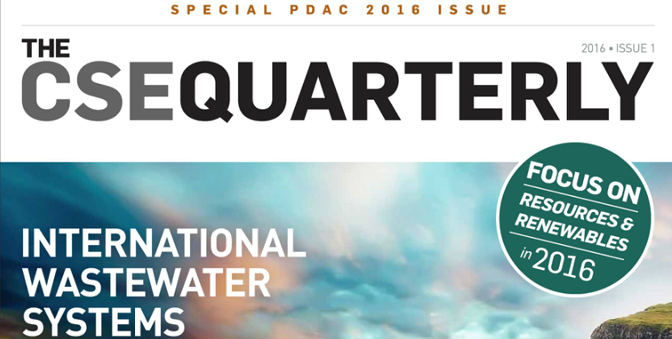
The CSE is proud to present the latest edition of the CSE Quarterly just in time for the PDAC 2016.
This edition of the CSE Quarterly focuses on companies active in the resources and renewables spaces. The entrepreneurial firms listed in this edition showcase the diversity of opportunities that the CSE listed companies are pursuing and are great example of why the CSE is the Exchange for Entrepreneurs.
The companies profiled in this issue are:
International Wastewater Systems Inc. (CSE:IWS)
Western Uranium Corporation (CSE:WUC)
Earth Alive Clean Technologies (CSE:EAC)
Pasinex Resources Limited (CSE:PSE)
MGX Minerals Inc. (CSE:XMG)
DNI Metals Inc. (CSE:DNI)
In addition, sure to read the latest message from the Canadian Securities Exchange CEO, Richard Carleton, as well as the editorial feature by Steve Kanaval from Equities.com
To have The CSE Quarterly delivered directly to your inbox, sign-up below:
CEO of the CSE, Richard Carleton at CSE Day Toronto, Spring 2015
Earlier this month, Canadian Securities Exchange CEO Richard Carleton sat down for an interview with Peter Murray of Kiyoi Communications to discuss the latest developments at the CSE. Among the topics covered were the performance of the CSE in 2015, the expanding international profile of the CSE, the landscape for early-stage firms raising capital as well as the upcoming enhancements to the CSE.
Below is the full text of their interview. (Questions from Peter Murray have been placed in bold for clarity):
1. Let’s start with a review of 2015 in general. The Canadian Securities Exchange issued a press release recently highlighting continued growth in issuers listed, trading volume and other key metrics of performance. Can you comment on these and is your success a sign of companies finding that financing and other business activities became somewhat easier last year?
Actually, I think it is an article of faith in the industry that it is more difficult at the moment to raise public capital than it has likely been in a generation. And that is not just for companies that operate in the commodities space — given what we’ve heard from the entrepreneurial community it has been a challenge for companies in all sectors to raise capital over the past 12 months.
That is why I believe it is important that despite those difficult conditions we grew considerably last year over the record pace we set in 2014. We had the strongest year ever in terms of trading volume and grew the issuer base by 20%, among other achievements. I think the underlying message of the exchange, which is that we work with a broad number of industry participants to deliver the lowest cost of public capital, really is resonating with the entrepreneurial community. And frankly it is perhaps as a result of the difficult times that we have seen our business continue to grow.
2. It was encouraging to see several companies based in the United States make their public trading debuts on the Canadian Securities Exchange in 2015. Why did they choose the CSE over the alternatives and how is the listing process different for a company domiciled outside of Canada?
As with a Canadian company, an international company has to become a reporting issuer in one of the Canadian provinces before they qualify to list on the CSE. That is accomplished in one of a variety of ways, which can include an offering or non-offering prospectus. At some point in the not too distant future there will be the opportunity to do so via an offering memorandum. There are also the traditional techniques of reverse takeovers and asset purchases that have been used in Canada for years for private companies to become public.
For US companies in particular, I think it is fair to say that regulatory costs and civil liability burdens have put a significant hole in their early stage public capital markets. Much of the early stage capital is coming from venture capital and private equity sources. Companies look at the public market as an exit, not necessarily as a means of raising growth capital. So, when people who need to raise from $5 million to $50 million to build a company understand that you can do that in the public markets in Canada, it becomes a very attractive option.
Additionally, I would point out that entrepreneurs who take their companies public can often retain more control over the future direction of the enterprise than if they accept investment from a venture capital or private equity firm. You often see venture capital and private equity investors exert a very heavy hand on the future direction and management of businesses. From a cost perspective and that of the ability to control your destiny, people around the world find Canada a very compelling place to raise growth capital.
3. Can you give us some feedback on your interaction with issuers in 2015? And looking forward, what do you sense their goals and expectations are for 2016?
Let me start in more general terms by highlighting the results of a series of events we instituted in 2015 called CSE Days. These took place in Vancouver, Toronto, Montreal and New York. We invited issuers from each of the Canadian cities to spend a day with us talking in the morning about issues of specific interest to listed companies. We also focused on helping companies improve their presentation skills by having coaches work with their executives. We concluded the day with a mixer event where the corporate finance community was invited to meet the issuers and the keystone was the companies delivering two-minute pitches to the audience. Our issuers universally found these days to be helpful. They also found it worthwhile to meet not just their peers in the CSE issuer group, but to be introduced to a broader cross-section of the advisors and corporate finance professionals working in each city.
As far as what issuer goals and expectations are for 2016, I don’t think anybody is expecting conditions to change dramatically for the better in the commodities markets. The belief seems to be that it will continue to be a challenging environment for early stage companies of all kinds to raise capital. That being said, it is abundantly clear that there is more investor interest in technology, biotechnology and biopharma undertakings. Through the applications we are receiving we see what seems to be a general rotation of investor interest into those sectors.
4. Are there any other key developments from 2015 to highlight?
One of the first things the Canadian Securities Exchange decided it had to deliver was full electronic access to all of the discount brokerages operating in Canada, given that retail investors play such an important role in junior capital formation. It actually took until spring of last year to bring on board the last of the bank discount brokerage firms. And we saw as each of them came on over the last couple of years, significant enhancements in both the trading activity and market quality. That was a really important milestone, not just for the organization but for the issuers, and one I am pleased to say that we finally completed last year.
5. As we enter 2016, what are the trends you hear from the investment community, and how will these affect the CSE and its issuers? How can the CSE influence those trends?
As we start 2016 there is no shortage of concerning news. I recently heard Ian Russell, President and CEO of the Investment Industry Association of Canada, present the results of his organization’s CEO survey conducted in November, where they spoke to almost 200 of the chief executives of the registered investment dealers in Canada. The picture they painted was quite bleak. They anticipate that costs, chiefly driven by regulatory initiatives, will outstrip any revenue growth, and that there will continue to be a large number of independent dealers in financial distress as a result of difficulties in traditional strengths of the Canadian economy.
In working with that community we continue to look for ways to reduce their cost of operating wherever we can, to try to bring more business opportunities to the dealer community and ideally lower their cost of operations.
There are definitely things we can do as an exchange as well and international initiatives are a good example. When we attract companies from overseas to list in Canada, they are going to use Canadian dealers, lawyers, accounting firms and investor relations professionals to manage their go-public process. So we are bringing net new business opportunities to the local community.
In addition, we certainly are going to be part of the industry discussion about ways to try to improve the trading process in a manner that protects enterprise values for issuers and their investors.
6. Let’s discuss one of your international initiatives. The Canadian Securities Exchange signed a Memorandum of Understanding with the Taipei Exchange in November, and this comes on top of a close working relationship with the OTC Markets group in the United States. What benefits are there to the exchange itself from such international relationships? How about for issuers?
Really, the two questions are intertwined. We find that when companies list in jurisdictions in addition to Canada and have raised money in those jurisdictions, their liquidity profile improves overall. We see tighter spreads and deeper markets for domestically listed companies that are also quoted on the OTC market in the US or Frankfurt in Europe.
Many Canadians aren’t aware that Taiwan is a very dynamic economy heavily involved in precision manufacturing. Taiwan has a sophisticated material science community and in fact enjoys a large positive trade balance with the People’s Republic of China.
The issue that business people in Taiwan have, which is very familiar to Canadians, is that notwithstanding that expertise, it is a relatively small economy, with a population of some 22 million.
As a result, Taiwanese companies are looking for access to the global economy and over the years, for a variety of reasons, have looked to the United States for public capital and to establish that North American presence.
The CSE has always had a strong proposition for companies looking to access North America but at a significantly lower cost and regulatory footprint than they would see in the United States. We had an opportunity to meet with a variety of members of the Taiwanese financial community, including the Taipei Exchange, which is the medium and small enterprise exchange there. We have agreed to compare notes and look for opportunities to promote our issuers in the Taiwanese market, while also searching for opportunities for issuers on their market to potentially list in Canada and obtain access to North America.
For our issuers it is really the same thing. Taiwan has a sophisticated marketplace which is prepared to invest in early stage stories, especially in the technology space. We have a lot of companies that are looking to obtain an Asian presence, and just as we are a low-cost alternative to the United States, there are a lot of advantages for companies to use Taiwan as their stepping stone into the Asian market.
7. The regulatory landscape is constantly developing. Anything to comment on with regard to change at the CSE or ongoing collaboration with regulatory authorities?
We will be publishing proposed changes to our listings criteria in the next few weeks. Keep in mind that we have not amended the thresholds to qualify for listing since the material was originally filed with the Ontario Securities Commission in 2002. We will be raising the bar, but I don’t think the new standards would have had an impact on companies we have listed over the last couple of years had they been in place when those companies applied to us.
We will also likely introduce continued listing requirements that will entail certain enterprise value, size and business activity with the notion that the companies listed on the exchange must have a workable business plan and sufficient capital on hand to fund the programme for a reasonable length of time.
Another initiative is cooperation with the market-making community in Canada to see how we can incent their participation in our markets to a greater degree than happens currently. This will be with a view to ensuring there is a meaningful, two-sided market for every security listed on the Canadian Securities Exchange. It is a real challenge for junior markets – and this is true around the world – to provide for appropriate levels of liquidity for early stage companies, but we have a dealer community in Canada that is working with us to come up with solutions.
8. How do you continue to define the CSE in 2016? How does it differentiate itself from the other exchanges that small-cap and/or early stage companies might consider when they are thinking about going public?
It may sound like a cliché, but we always bring everything back to our overall mission, and that is to deliver the lowest cost of public capital to entrepreneurs looking to tap the Canadian equity markets. With that very clear mandate in mind we can measure all of the activities we are contemplating and if we are making progress in that direction then we know we are on the right track. We believe that not just given our fee structure but the overall cost structure for companies listing on our exchange, that they are in fact achieving the lowest cost of public capital as things stand currently.
We also need to continue to emphasize that the CSE serves entrepreneurs and that we have built an ecosystem that puts them in the middle. We are an independent exchange guided by the voice of the entrepreneur and that truly sets us apart.
Volatility in pricing and trading volumes are par for the course on any marketplace. What stood out in 2015, however, was not the usual swings in market sentiment but rather the consistency with which good news stories were able to be found on the CSE.
Despite a challenging year for many publicly listed firms, especially in the small cap space, in 2015 the Canadian Securities Exchange saw record trading volumes (2.47B shares traded), the highest number of listed securities on the exchange (316) and 273 financing deals that raised a total of $194M.
The details of the performance of the CSE in 2015 were shared as part of their latest news release. While the numbers confirm the exchange continues to grow, the figures also validate the model that the CSE offers to emerging and early stage firms who prioritize strategic growth.
CSE Achieves Major Milestones
In addition to the stats and figures, 2015 was an important year at home and internationally for the CSE.
Within the Canadian DIY investor space, the integration of all major Canadian discount brokerages meant that self-directed investors could directly access CSE-listed securities from any Canadian online brokerage.
Internationally, continued dialogue with international business leaders at the World Economic Forum sessions in Toronto and Miami, a CSE Day event with the OTC Markets Group in New York City as well as a memorandum of understanding signed with the Taipei Exchange demonstrated the CSE’s commitment to building an internationally recognized venue for listings and for innovation.
A Cause for Optimism
As the “Exchange for Entrepreneurs,” the CSE knows that key ingredients to success are resilience, innovation and of course, optimism.
Publicly listed firms who have made the switch to listing on the Canadian Securities Exchange have already reaped the benefit of lower operating costs. This, in turn, has provided these and other CSE-listed issuers with the resources to focus on strengthening their businesses.
By recognizing and responding to the need for a more efficient platform to raise public capital, the CSE looks to 2016 with a renewed sense of optimism. Like 2015, it seems that if investors and entrepreneurs are looking for good news in the markets, they may not have to look much further than the CSE to find it.
The CSE Quarterly Profiles Notable Listed Companies
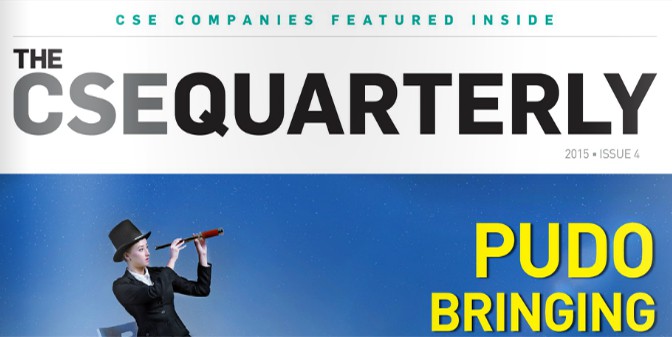
The CSE is proud to present the seventh edition of its quarterly publication – the CSE Quarterly – Issue 4 – 2015 is now live! This issue profiles companies operating in a variety of industries including delivery technology, medical devices, non-dairy milk, and more. The companies profiled in this issue are:
PUDO Inc. (CSE:PDO)
H-Source Holdings Ltd. (CSE:HSI)
Global Gardens Group Inc. (CSE:VGM)
Golden Leaf Holdings Ltd. (CSE:GLH)
RIWI Corp. (CSE:RIW)
VirtualArmour International Inc. (CSE:VAI)
To have The CSE Quarterly delivered directly to your inbox, sign-up below:
The CSE Quarterly Profiles Notable Listed Companies
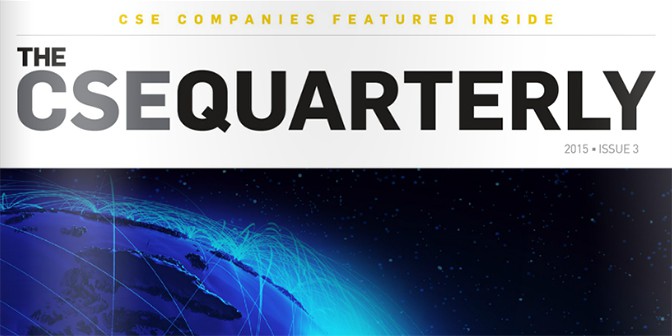
The CSE is proud to present the sixth edition of its quarterly publication – the CSE Quarterly – Issue 3 – 2015 is now live! This issue profiles companies operating in a variety of industries including broadband technology, microwave energy, oil spill clean-up, and more. The companies profiled in this issue are:
Lite Access Technologies Inc. (CSE:LTE)
Canadian Metals Inc. (CSE:CME)
Targeted Microwave Solutions Inc. (CSE:TMS)
Robix Alternative Fuel Solutions Inc. (CSE:RZX)
IGEN Networks Corp. (CSE:IGN)
BioNeutra Global Corporation (CSE:BGA)
To have The CSE Quarterly delivered directly to your inbox, sign-up below:
2015 has been a phenomenal year for the Canadian Securities Exchange.
With close to 300 listings now on the Exchange for Entrepreneurs, over 150 financing deals in 2015 , strong trading volumes and well over $110 million dollars in capital raised, publicly listed firms have found a solution in the CSE’s innovative listing model.
What’s so innovative about the CSE’s approach to public listing? In a word: simplicity.
The CSE is disrupting the securities exchange landscape in Canada because they believe that minimizing the complexity of being public without sacrificing transparency or accountability is a win-win-win. It’s a win for listed issuers, for investors as well as for the CSE.
With over 40 securities choosing the CSE in 2015, and more on the way, find out the five reasons causing more firms to take notice of and join the CSE in this video featuring CEO of the CSE, Richard Carleton.
It looks like 2015 is shaping up to be one of the best years so far for the CSE. As of the end of July, 40 new securities joined the Exchange for Entrepreneurs in 2015 and there have been just over 150 financing transactions totaling $102 million.
CSE trading volume continues to remain healthy as does interest in raising capital on the exchange, especially in technology and diversified industries.
Read on to find out more about the exciting firms joining the CSE as well as the strength of financing activity in what was supposed to be a quiet month.
New Listings
Despite the summer slowdown, the CSE continued to grow by listing two new issues to the Exchange in July. The CSE would like to welcome Carpathian Gold Inc. (CSE:CPN), an exploration and development company, and PUDO Inc. (CSE:PDN) an innovative customizable parcel pick-up and drop-off service, to the Exchange for Entrepreneurs.
Financing Activity
Deal activity in July continued to make 2015 one of the strongest on record for the CSE.
With 27 financing transactions taking place, financing activity tied January with the highest number of deals in a given month this year. Just over $14 million was raised in July, which was slightly lower (18%) than July 2014, however the total amount of funds raised year-to-date crossed the $100 million dollar mark representing a 14% increase over the same period last year. Technology and Diversified Industries continue to see growing interest in deal activity compared to the same point last year.
CSE Trading Activity
The top five most active issues on the CSE by volume for July were:
Nutritional High International Inc. (CSE:EAT)
Matica Enterprises Inc. (CSE:MMJ)
Affinor Growers Inc. (CSE:AFI)
Global Hemp Group Inc. (CSE:GHG)
DealNet Capital Corp. (CSE:DLS)
The top five most actively traded issues on the CSE for July were:
Cannabix Technologies Inc. (CSE:BLO)
Nutritional High International Inc. (CSE:EAT)
Aurora Cannabis Inc. (CSE:ACB)
DealNet Capital Corp. (CSE:DLS)
Supreme Pharmaceuticals Inc. (CSE:SL)
Be sure to follow us on Twitter, LinkedIn or visit the bulletins section of the website for timely updates on trading and listing activity at the CSE.
Publicly listed companies continued to show strong interest in the Exchange for Entrepreneurs in June. With 11 new listings and $17 million in financings, the CSE is quickly closing in on the milestone of 300 listed securities. As of the end of June there were 291 listings from 269 issuers. Read below for further details.
New Listings
The CSE welcomed 11 new listings to the Exchange last month. There were six equity listings, one of which was an IPO (Squire Mining Ltd.), from a variety of sectors as well as five bonds listed. Here are the new additions:
Expedition Mining Inc. (CSE:EXU)
Light Access Technologies Inc. (CSE:LTE)
Captiva Verde Industries Ltd. (CSE:VEG)
Gravitas Financial Inc. Debentures (CSE:GFI.DB.B)
Squire Mining Ltd. (CSE:SQR)
Global Gardens Group Acquisition Corp. (CSE:VGM)
Alliance Growers Corp. (CSE:ACG)
The Province of Manitoba also listed four of its Series 15 Builder Bonds under the following symbols:
Three-year annual fixed rate – to June 15, 2018 (CSE:BMB.DB.A)
Five-Year Annual Fixed Rate – to June 15, 2020 (CSE:BMB.DB.B)
Five-Year Compound Fixed Rate – to June 15, 2020 (CSE:BMB.DB.C)
Five-Year Annual Floating Rate – to June 15, 2020 (CSE:BMB.DB.D)
Financing Activity
Deal activity in June continued to remain robust with $17 million in financing deals taking place. Year to date, deals were up 25% as of the end of June 2015. The technology and biopharmaceutical sectors continue to attract strong deal activity.
CSE Trading Activity
Trading volume strengthened by 30% in June compared to May. Just over 200 million shares traded in the month across 14.7 thousand trades. For more details on CSE trading activity for June, click here.
The top five most active issues on the CSE by volume for June were:
KWG Resources Inc. (CSE:KWG)
Nutritional High International Inc. (CSE:NHL)
DealNet Capital Corp. (CSE:DLS)
Affinor Growers Inc. (CSE:AFI)
Umbral Energy Corp. (CSE:UMB)
The top five most actively traded issues on the CSE for June were:
Cannabix Technologies Inc. (CSE:BLO)
Lite Access Technologies Inc. (CSE:LTE)
Nutritional High International Inc. (CSE:NHL)
DealNet Capital Corp. (CSE:DLS)
InMed Pharmaceuticals Inc. (CSE:IN)
Be sure to follow us on Twitter, LinkedIn or visit the bulletins section of the website for timely updates on CSE trading and listing activity.