Investors are constantly on the hunt for disruptive products that completely change an industry’s dynamics. Disrupting the approach to manufacturing a game-changing product thus seems like taking things to an even higher level.
That is what HydroGraph Clean Power (CSE:HG; OTCQB:HGRAF) has been working on since 2017, when the company was formed to pursue the production of graphene in a way that resulted in higher purity, was more cost-effective, and more environmentally friendly than conventional methods.
Fast-forward to 2025 and HydroGraph has reached its objective, with a readily scalable process that yields high-quality graphene while adhering to the founding team’s tenets.
Graphene is perhaps best described as a super-material. Many times stronger than steel, it is also a highly efficient conductor of electricity and heat, impermeable, and very flexible, among other qualities. The process of incorporating it into products can require specialized knowledge, but it still has found a home in a long list of items, with composites, electronics, and biomedical products among the categories tipped to lead future applications.
HydroGraph’s core technology is its patented detonation synthesis process, which is quite a departure from methods that begin with graphite from the ground. Instead, HydroGraph detonates hydrocarbon gases using acetylene and oxygen to generate synthetic graphene by turning the gas into a powder.
One aspect of the process that makes it unique, according to the company, is its simplicity. Conducting the detonation process with high-purity feedstock yields graphene with a purity level on the order of 99.8%. Consistency is another competitive advantage for HydroGraph, as the company has been able to produce a virtually identical product each time it has scaled up output.
And changing the details on the input side can produce different graphene types to meet the particular needs of a given customer.
Technologies like these need protection, and in this regard HydroGraph holds three patents at present, with another eight pending.
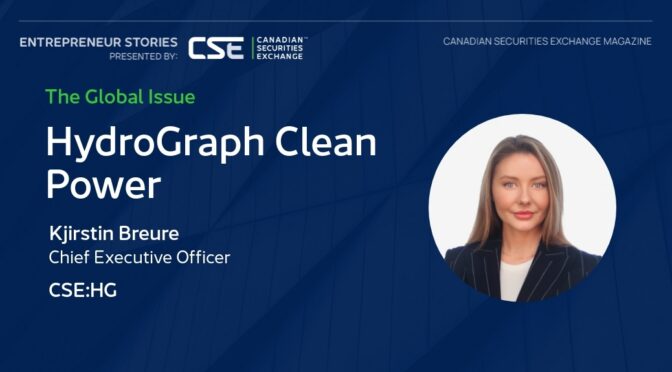
“A number of companies have tried to go around our patents and everything has been rejected by the U.S. Patent Office, so we feel strongly about our position in the market,” says HydroGraph Clean Power Chief Executive Officer Kjirstin Breure.
Breure, who joined the company as its Chief Operating Officer in 2020 before becoming CEO in 2024, holds an MSc in Materials Science and Engineering from Arizona State University and has spent over a decade involved with emerging technologies in the commercial sector, including machine learning, data analytics, and blockchain.
Commercialization of HydroGraph’s graphene is already underway, with more than 60 entities in various stages of testing it for potential inclusion in a wide range of products and industries.
One of those, Hawkeye Biomedical, is using HydroGraph’s graphene in its Lung Enzyme Activity Profile (LEAP) lung cancer biosensors. And in late September, HydroGraph announced a letter of intent with SEADAR Technologies, a developer of subsea sensing and surveillance solutions, to integrate HydroGraph’s graphene materials and coating technologies into current and future SEADAR undersea products.
Breure notes that the average development cycle for its customers is about 18 months. First is lab-scale testing, which leads to industrial trials where a potential customer experiments with HydroGraph’s materials. Assuming everything goes well, contract negotiation is the next step.
An important venue for interacting with potential clients in the graphene industry is the Graphene Engineering Innovation Centre (GEIC) at the University of Manchester. HydroGraph has its own laboratory at the GEIC, which has established itself as a hub for companies looking to integrate graphene into their products. With deep expertise on site and all the right equipment, the GEIC is the perfect location for graphene suppliers and users to explore real business relationships.
Current production capacity is 10 tons per year and new production units, in the form of the company’s patented Hyperion detonation chamber, can be built and brought onstream in as little as two to three months.
HydroGraph’s first commercial unit, a 13,000 square foot facility located in Manhattan, Kansas, started production in 2022. The company’s second production facility will be established in Texas, in part because that state is one of the best places to source the acetylene used in the detonation process.
Scaling up on the revenue generation front could feed quickly to the bottom line, as HydroGraph estimates that an outlay of US$10 million to US$15 million on production can generate more than $100 million in sales.
With the ability to quickly increase production capacity and a healthy pipeline of potential customers, it is reasonable to expect new developments coming to light before long.
“We will be announcing the gas partner that we are working with for a large-scale production facility where we have negotiated pipeline access for acetylene, and we are looking forward to announcing a relationship with the U.S. military,” Breure says.
Breure adds that HydroGraph is planning to provide an update on the status of its submission to the U.S. Environmental Protection Agency and that contract announcements emerging from the company’s commercial pipeline are likely.
“We have between 10 and 15 clients that are really in that last stage that could convert into revenue within the next year,” Breure says, adding that the company has generated “small amounts” of revenue thus far but expects a more significant revenue stream to be “kicking in next year.”
This story was featured in Canadian Securities Exchange Magazine.
Learn more about HydroGraph Clean Power https://hydrograph.com/.