
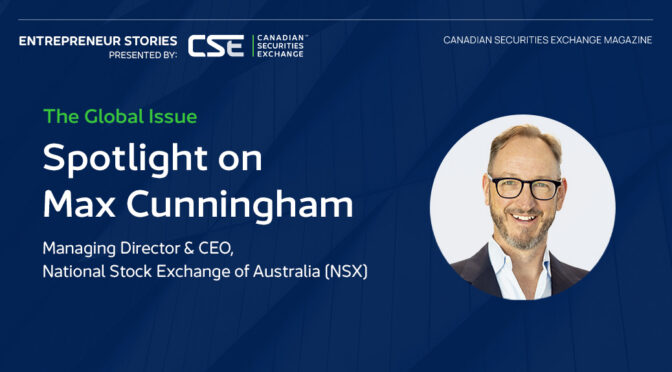
Tell us a bit about yourself. What was your journey to the NSXA?
I’ve been in capital markets for over 30 years. I was a foundation employee when Macquarie Equities opened a retail broking business in Australia in 1994 and was sent to London with Macquarie in 1997 to help build out the U.K. institutional business.
In 2004, I moved to New York to perform a similar role with Goldman Sachs, before returning to Australia to head up Goldman’s capital markets business in 2008. I shifted to ASX and the exchange world in 2013, where we built a strong franchise around tech listings, including achieving great success in the U.S., Israel, and Ireland.
Exchanges play an important role in helping companies raise capital, and I believe that role had been increasingly neglected in Australia. The National Stock Exchange of Australia (NSXA) was attractive to me as an underutilized public market with a valuable listings licence. I saw a great opportunity to rebuild the NSXA as a competitor in the venture and start-up space, very similar to CSE’s successful execution in Canada.
For those of us who are unfamiliar with the NSXA, can you please provide a bit of background on the exchange, as well as some context around the current challenges and opportunities for public companies in the Australian capital markets?
The National Stock Exchange of Australia has been around in various guises for over a century. Part of its history includes the Bendigo Stock Exchange, formed in the 1860s to fund the Victorian gold rush. This century, NSXA has led many innovations, including tokenizing wine units in 2002, trading taxi plates in 2006, and, more recently, operating a market for agricultural cooperatives to trade shares.
As CEO, what is your vision for NSXA over the next few years? For this partnership?
Our goal is simply to innovate and compete. On the innovation front, we intend to invest in cutting-edge technology to improve trading capability, provide additional services, and expand our listings offering. Competition is something you create as an exchange, and the reality is that small miners, pre-revenue tech, and life sciences companies are increasingly finding it difficult to IPO in Australia, and we can assist with that. The same applies to junior explorers listed in Canada.
Our partnership with CSE will assist on all fronts. It offers experience and expertise in a similar market, provides technology and marketing support, and a great existing network of issuers to call upon. Moreover, Australians and Canadians are natural allies. The NSXA and CSE teams have clicked together very well. That’s obviously great for our staff, but it’s also beneficial for our customers and other stakeholders.
The collaboration opens the door for, among other things, dual listings. What are the benefits for retail investors and public companies in both Australia and Canada?
In reality, we have similar markets and economies, with large pension plans and individual investors looking at opportunities, especially in the mining sector. In my view, Canada and Australia have slightly different investment, risk, and interest rates cycles, with Canada slightly skewed toward the U.S. and Australia toward Asia. This often presents “valuation arbitrage” that companies can potentially benefit from by being listed in both markets. The prospect is exciting.
Looking ahead, how do you expect Australia’s capital markets landscape will evolve, especially as it relates to international opportunities?
Australian pension pools are growing exponentially, and there is a big drive to invest in local tech and keep those businesses local, especially their intellectual property. This combination should see more international opportunities to dual list so as to take advantage of that combo. Indeed, the Australian government has committed AUD$1 trillion of investment in the U.S. over the next decade. There’s no reason why a large part of that can’t be realized through dual listing opportunities. As I look ahead, I see a dynamic and healthy future.