For three decades, central nervous system (CNS) drug development was a tough space for investors, scarred by failed bets on Alzheimer’s disease, plateauing first-generation antidepressants, and setbacks in safety and efficacy.
But advances in receptor-selective chemistry and so-called “biased agonism” – steering toward therapeutic pathways and away from areas that cause side effects – are reviving interest in the field.
Successes such as esketamine for depression or cannabinoids for epilepsy have shown that carefully targeted mechanisms can deliver commercial as well as clinical breakthroughs.
That shift is fuelling a new wave of investment in CNS-focused solutions, with several biotech companies absorbed by larger players in recent years.
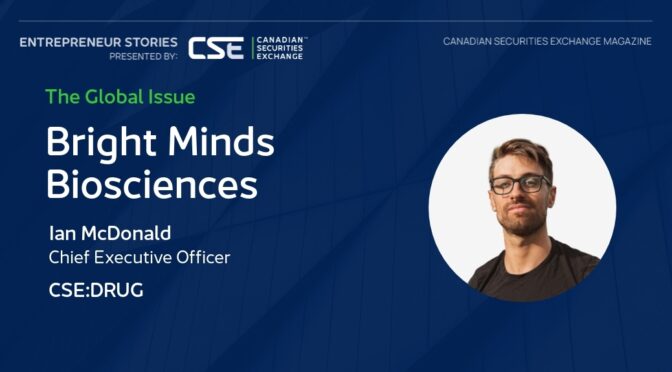
One of the companies that illustrates this shift is Bright Minds Biosciences (CSE:DRUG), which is now in Stage II trials for its lead epilepsy drug. The company’s dramatic share performance in the past 12 months, involving appreciation of approximately 5,000%, is why investors come to the biotech space. Bright Minds has certainly delivered.
The company was founded seven years ago by former investment banker and current Chief Executive Officer, Ian McDonald, Dr. Alan Kozikowski, a pharmaceutical entrepreneur and one of the most prolific researchers in psychedelic drug discovery, and Dr. Gideon Shapiro, a veteran of CNS drug discovery with senior roles at Sandoz-Novartis and Forum.
Bright Minds is seeking to prove that finely tuned serotonin-targeting drugs can succeed where other compounds have fallen short.
Its lead compound, BMB-101, is being tested with two forms of childhood epilepsy, with data expected around the end of this year.
The scientific premise is straightforward but ambitious: BMB-101 selectively activates the serotonin 5-HT2C receptor, known as 2C, a target known to influence neuronal activity.
Activating that receptor indirectly boosts levels of the neurotransmitter gamma-aminobutyric acid (GABA), which calms neuronal pathways to aid normal brain function and helps prevent the electrical discharges that result in epilepsy.
Several other medicines also target 2C, but BMB-101 avoids closely related receptors linked to undesirable effects.
Past drugs in this space, including the diet drug fenfluramine, were plagued by serious cardiac and psychedelic side effects because they also activated the 2B and 2A receptors.
Bright Minds’ molecule is designed to bypass those problems and also to avoid the desensitization and tolerance build-up that has undermined many chronic CNS therapies.
“Our compound is an advancement from that – a safer version that doesn’t have the 2A and 2B liabilities,” says McDonald.
BMB-101, which has IP protection out to 2041, is in Phase II studies for two types of epilepsy.
One is developmental epileptic encephalopathies, catastrophic epilepsies which begin in childhood and continue throughout life, with high mortality rates and patients who generally experience a range of problems stemming from the epilepsy.
“We’re also looking at a separate population with absence epilepsy, which isn’t very well treated at the moment,” says McDonald.
“Only a couple of therapies have been approved for it, and there’s a significant unmet need in that patient population.”
He says these current trials are due to produce results around the end of the year.
An upswing in M&A in recent years suggests that large pharmaceutical groups are willing to pay for validated serotonin 2C assets.
Zogenix, which commercialised fenfluramine, was acquired by Belgium’s UCB for up to US$1.9 billion in 2021; GW Pharmaceuticals was bought by Jazz Pharmaceuticals for US$7.2 billion in the same year; in October 2024, Denmark’s Lundbeck paid US$2.6 billion for Longboard Pharmaceuticals.
This latter deal was potentially the most relevant for Bright Minds, as Longboard’s compound operates with a similar serotonin 2C mechanism, and it had recently completed its Phase II study when the deal was done.
McDonald believes his lead compound could be superior, with high selectivity and applications in treatment-resistant epilepsy.
“In chronic dosing situations these other compounds often develop tolerance, but our molecule is designed to minimize or eliminate that.”
Within the serotonin 2C receptor there are different signalling pathways.
BMB-101 works exclusively via the pathway responsible for the therapeutic effect, known as the Gq-protein signalling pathway, and avoids the beta-arrestin pathway, which is responsible for tolerance development.
In earlier tests, the molecule demonstrated efficacy in numerous models of generalized seizures.
While McDonald says it is “potentially a best-in-class drug,” he acknowledges that a lot can go wrong in clinical trials. “The difference here is we know the mechanism works and we know our drug is hitting it.”
The reason Longboard was bought even before it had started Phase III studies, and that Bright Minds shares skyrocketed around 1,500% in the same week as that deal, is that epilepsy trials have strong predictability.
“If you succeed in Phase II, you’re likely to succeed in Phase III,” says McDonald. “Also, fenfluramine was proven to work, and Longboard’s compound was superior. It was lower risk than many other drugs at that stage. Our compound works on the same mechanism, but we have the biased agonism feature against tolerance development – and ours is more convenient too. Longboard’s compound must be given three times a day and refrigerated throughout. We don’t have those issues.”
While some investors may be crossing their fingers for suitors to swoop after Phase II, the company has a cash runway through to 2027 to take the molecule to the edge of commercialization.
There is also a wider portfolio of intellectual property in the pipeline in neurology and psychiatry, with multiple programs of interest, all built off the strong medicinal chemistry background of its co-founders, with compounds that accentuate the benefits of the mechanism while avoiding negative side effects.
One indication in the same 2C space is a debilitating disease called Prader-Willi syndrome, which has around 10,000 patients in the U.S. and starts in childhood, with patients generally having a developmental disability and experiencing some neuropsychiatric symptoms.
Others include BMB-201, a non-hallucinogenic psychoplastogen for treatment-resistant depression.
Those additional programs may offer upside optionality, but the company’s value will be determined by whether BMB-101 delivers the pivotal data investors are betting on.
If BMB-101’s data lives up to McDonald’s billing, the company could suddenly find itself on more than a few corporate shopping lists.
This story was featured in Canadian Securities Exchange Magazine.
Learn more about Bright Minds Biosciences https://brightmindsbio.com/.