
Often when we discuss life sciences, particularly as investors, the human element gets lost. The focus tends to be on the pipeline, clinical and preclinical progress, data, efficacy, cash runway, and addressable market. These and other inputs can be plugged into a model to provide insight into a company’s chance of success.
But this process ignores the point of the business: to help people recover, to fight illness, or in the case of late-stage disease, to add months or perhaps years to life. It also disregards the human sacrifice along the way. This is particularly true in cancer research, where end-of-life patients often volunteer in the hope that the next generation benefits from their experience.
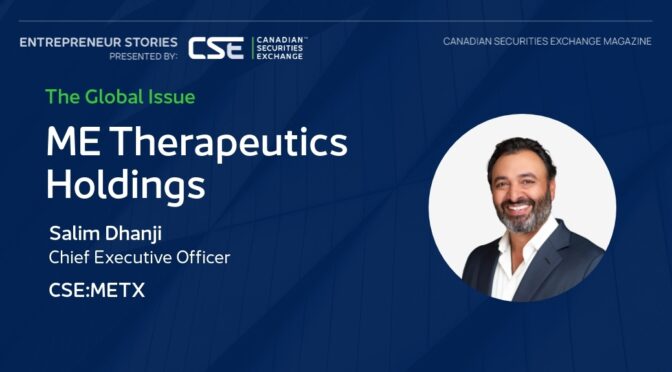
For ME Therapeutics (CSE:METX; OTCPK:METXF) Chief Executive Officer Salim Dhanji, the metrics that make the investment case are important but not the real litmus test. Rather, he is driven by a desire to change outcomes for people. Dhanji notes that he is at the stage in life where friends and family are succumbing to the ailments of middle and later years. The determination and passion that drive him are plain to see.
A researcher at heart, he wants a real, human dimension to his team’s work. “To use new technologies, and our knowledge of these technologies to create drugs to treat cancer patients in a personalized way, is something that really motivates me,” Dhanji tells Canadian Securities Exchange Magazine. “You’re starting to see that [in other areas of research], and I think that’s the really exciting bit; where you can potentially bring about real change.”
Dhanji earned his Bachelor of Science and PhD at the University of British Columbia and has more than 20 scientific publications and patents relating to cancer, autoimmunity, and inflammation to his credit. ME Therapeutics, founded in 2014, reflects that body of work.
The ME component of the company’s name stands for “myeloid enhancement,” a clue to the science behind its three drug development and discovery programs. Put simply, this involves reprogramming the immune response against cancer. The team is tackling one of oncology’s toughest problems: how cancers hijack the body’s own immune cells to shield themselves from attack.
ME Therapeutics is developing drugs that reprogram so-called myeloid cells. These normally regulate immune responses but in tumors often act as double agents, suppressing cancer-killing T cells and creating a cocoon around malignant tissue. Rather than designing medicines to target a specific mutation, ME Therapeutics is targeting the immune environment itself. That means its drugs could be used across many cancer types, much like today’s blockbuster immunotherapies such as Merck’s Keytruda or Bristol Myers Squibb’s Opdivo.
The company is working on three fronts. One program delivers synthetic messenger RNA into tumors to coax immune cells into action and turn “cold” tumors into “hot” ones that draw an immune response. A second program engineers in vivo chimeric antigen receptors (CARs) into immune cells directly inside the body, re-tasking both T cells and myeloid cells. A third antibody therapy blocks a protein called granulocyte colony stimulating factor (G-CSF), which fuels immune suppression and drives resistance to vascular endothelial growth factor (VEGF) drugs.
A key partner is NanoVation Therapeutics, co-founded by lipid nanoparticle pioneer Pieter Cullis, whose delivery systems enabled the first Covid-19 vaccines. ME Therapeutics is using NanoVation’s nanoparticles to ferry its mRNA payloads to immune cells while avoiding the liver, a common stumbling block.
Preclinical work is still early. Studies in mice and non-human primates are scheduled through 2026, with the first regulatory applications expected late that year.
ME Therapeutics’ ambitions are big, but, like most start-ups in the biotechnology space, so are the risks. It is also betting on next-generation technologies, such as in vivo CARs, that have yet to be proven in people. Still, with immuno-oncology drugs now among the industry’s top sellers and combinations extending their reach, investors are watching.
“If you can reprogram the immune environment rather than chase each new tumor mutation, the potential is enormous,” says Dhanji.
The G-CSF antibody program is the most advanced, though whether it or the therapeutic mRNA program reaches the clinic first remains to be seen. There is a case for the latter: the timeline to “spin up” an mRNA drug for a specific cancer is relatively short, as little as six to 12 months, Dhanji explains.
ME Therapeutics’ approach also has transformative potential in CAR therapy, which typically involves genetically engineered T cells trained to hunt and destroy cancer. Used to combat blood cancers such as leukemia, lymphoma, and multiple myeloma, success rates can be upward of 80%. But the process requires a blood transfusion, which is uncomfortable, and costs between $500,000 and $1 million.
Using ME Therapeutics’ method, Dhanji says, could ultimately pull the price down toward that of traditional gold-standard cancer treatments, as well as leverage myeloid cells in addition to T cells. “There is a lot of potential in some of the work that we’re doing in the lab, preclinically right now, and we think we can advance to the clinic very quickly,” he says. “So now, it’s really a matter of deciding which program we want to prioritize.”
As with all small-cap biotech, funding is an ever-present requirement. Dhanji says the company’s current runway is long enough to fund the first candidate to initial meetings with the FDA or Health Canada. After that, further investment will be needed.
An industry partnership with a large drugmaker is possible but uncommon at this stage. Dhanji wants intellectual property patent-protected before any such discussions take place. “I think one of the challenges is that we need to be able to protect our IP before we actually go and have these conversations, as the space is relatively fluid,” he explains.
Dhanji is not without ambition and would like to emulate Genentech, the founding company of biotechnology. It may be difficult to repeat the San Francisco giant’s success, but it is the pioneer spirit he admires, when budgets were spared to solve real human problems, not the balance sheet metrics that fixate Big Pharma.
Yet Dhanji is also a realist. “I do have to run a business, and I take that responsibility very seriously. But what gets me out of bed in the morning, what motivates me, is the old researcher’s curiosity and the hope our work may make a difference.”
This story was featured in Canadian Securities Exchange Magazine.
Learn more about ME Therapeutics https://metherapeutics.com/.