About This Video
How can Canada give growing businesses better access to capital—and Canadians more opportunities to invest in their success? 🇨🇦
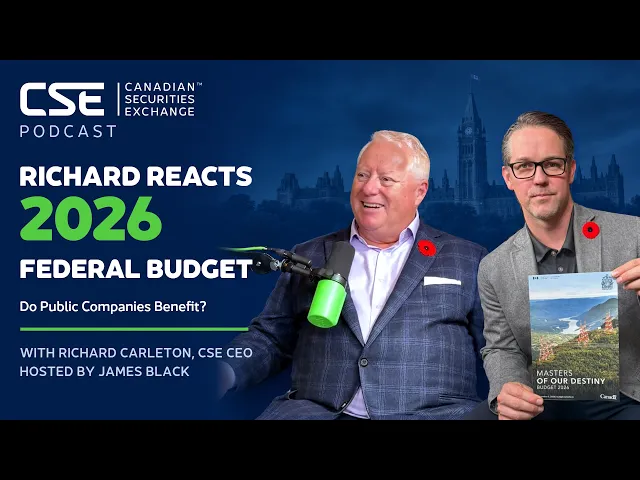
In this special reaction episode of the CSE Podcast, CEO Richard Carleton joins host James Black to discuss the Standing Senate Committee on Banking, Commerce and the Economy report, “From Potential to Prosperity: The urgent case for greater investment in Canada’s SMEs,” and what its recommendations could mean for entrepreneurs, investors and Canada’s public markets.
“The world has changed. Securities regulation has not changed with it. It is out of step.” — Richard Carleton, CEO, Canadian Securities Exchange
Having provided testimony to the Senate Committee on Banking, Commerce and the Economy, Richard shares his perspective on the barriers facing small and medium-sized enterprises, including:
• How tax policy can better support investment and business growth.
• Opportunities to broaden investor participation in early-stage financings and review Know-Your-Product rules.
• Why coordination between federal and provincial policymakers is essential to turning recommendations into action.
At stake is Canada’s ability to help promising businesses scale, retain innovation and ownership at home, and give more Canadians the opportunity to participate in that growth.
Watch the full conversation to hear why Richard sees a significant opportunity for progress—and what needs to happen next.
Read the Senate report and recommendations: https://sencanada.ca/en/info-page/parl-45-1/banc-small-and-medium-sized-enterprises
Subscribe for more great CSE insights and interviews here: https://go.thecse.com/CSETV-Subscribe
STAY CONNECTED WITH THE CSE
=============================
- NEWSLETTER: https://go.thecse.com/CSE-Mailing-List-Subscribe
- PODCAST: https://blog.thecse.com/cse-podcasts/
- INSTAGRAM: https://www.instagram.com/canadianexchange/
- LINKEDIN: https://ca.linkedin.com/company/canadian-securities-exchange
- FACEBOOK: https://www.facebook.com/CanadianSecuritiesExchange/
- TWITTER: https://twitter.com/CSE_News
- BLOG: https://blog.thecse.com/
- WEBSITE: https://thecse.com/
- MAGAZINE: https://issuu.com/thecse/docs
Read the TranscriptAuto-generated by YouTube; names and terms may be misspelled.
Back with the CSE podcast and your host James Black and this is a special reaction episode with our CEO Richard Carlton. today we're talking about the from potential to prosperity report. This is something that Richard actually had a hand in informing. the subtext for this is the urgent case for greater investment in Canada's SMEs. Richard, this was a product born from testimonial to the Senate Committee
on banking, commerce, and the economy. This one was hitting the the waves this week. A lot of people were involved in in in the construction of this report, many senators, but also a lot of people informed it from the community that we operate in in the small business world. And so there's a lot of ways we can cut this one down, but and
it's a fairly lengthy report. It's about 64 pages in its entirety with a lot of research cited in it. So maybe just for the viewers, let's take a step back. How did How did we get involved in this? Where were you involved in the Senate Committee report back I think in February or March when you testified or provided testimony to the committee in Ottawa
virtually. >> So the Senate Banking Committee is one of the regular standing committees of the Canadian Senate. it by time is safely ignored by the political class in Ottawa. but there are other times when the committee is populated by experts and folks with a strong background in capital markets, for example, where their voice can in fact be very influential in policy-making
circles in in Ottawa. And this is really one of those times. there are a number of new senators who are on the committee with strong backgrounds in Canada's capital markets and they're really looking for ways in which they can make Canada's capital markets better. And so they concluded that they would particularly focus on small and medium-size enterprise in Canada. And they would hold a series of hearings
as you say in Ottawa or virtually. And those took place last spring in in March and April. And I was certainly privileged to be able to provide testimony to the to the committee. And it was a very engaged group. They asked a lot of questions. We made some specific recommendations about areas that the committee should look at. And they heard from a number of other folks from across the industry academics
practitioners very broad set of opinions that were provided to the to the committee. They then took the summer and early fall to draft a report which can be summarized effectively into eight recommendations. Now the interesting thing of course is that as a federal committee and understanding that capital markets are regulated at the provincial level largely particularly the equity capital markets. There's kind of only so much that they
can do specifically within the within the federal realm. And five of the eight recommendations are actually directed at the federal government. And essentially it's things like establishing a permanent mandate with a cabinet level official to champion the interest of small and medium enterprise in in Canada with a staff and a budget with engagement from the community to ensure that in fact policies as they are created made and that's across the full range of
federal government activities, taxation is obviously a big one. that they in fact advance the cause of small and medium enterprise in Canada because again, it sounds trite to repeat over and over again, it is the true engine of growth in Canada and is the largest source of wealth creation in the country, these companies. And so, there's been a feeling those of us of course who are in in the
in the war dated day understand how challenging it is for entrepreneurs to raise capital from Canada's public capital markets. There many things that we could do better to improve the lot and to in fact provide clear runway for more of these companies to to succeed. >> Yeah, no. I I mean, I think that's the premise that everyone can agree on from the start is you don't have the big companies unless you have
the little companies. And the other thing that came through a lot of this was, you know, the threat of offshore investment and the threat of companies that get invested in Canada leaving Canada as they become more mature and larger. So, you know, brain drains and, you know, VCs coming in and taking out companies before they even get to the public market and many Canadians losing opportunities to grow with these
companies. and likewise investors, a lot of European investment coming into these issuers and US investment which we see with our own client base. you walked into the Senate Committee and maybe we we can't go through everything here because this is too broad, but >> [snorts] >> there are things that are very particular to us in the capital markets and I think you had a couple of items
you took to the committee that you were very passionate about. Maybe you can just summarize those and then we can see if it came through at the end in some of the recommendations they made. >> well, again, I don't think that we were singing out of tune with many of the people that were presenting to the committee. So, it would be a little presumptuous to claim
responsibility for some of the recommendations. But, I will say that they do in fact jive quite closely with many of the themes that we were presenting. the key thing, of course, is you know, at first and foremost, again, because we're talking to the federal government, is tax policy. And there are a lot of ways in which tax policy, whether it's the very high, by comparison to our peers,
in the G7 and around the world, personal income tax rates. it's the way in which we double tax dividend income. So, again, people invest in more mature companies that are spinning off dividends, in fact, face double taxation. It's not properly integrated into the tax system. There's lots of other anomalies. For example, access to certain federal government programs like the science and research tax credit, shred. in which as soon as you stop being
a Canadian-controlled private company, your access to that capital in fact dries up considerably, even though private company, public company may be indistinguishable otherwise. so, again, no reason for that to happen. >> Yeah. >> So, we went through a lot of the anomalies in the tax federal tax policy, which they can directly impact. And in fact, we do see many of those measures in fact pointed out and with with a
call to action to the federal government to address many of these anomalies in the tax system. Also, at the federal level, there is the potential to support small and medium enterprise through the in effect procurement program. They're obviously huge consumer of information technology and various goods and services. And again, it's not clear that in fact the government is providing advantages to smaller
companies in fact who as as a consumer itself. So so that that's an area of focus from from the committee. there's also a strong component of intellectual property protection that you know, we don't necessarily live in a culture of where we appreciate that in fact in a in a in an economy and and of course, you know, my old friend Jim
Balsillie is is is on this on on a regular basis. It it it it's not, you know, the old days where a steel foundry or a machine tool was the asset that generated wealth. It's intellectual property that in fact is the key wealth chain generator now. It's the intellectual property behind chip designs around all sorts of different industrial processes and and and so on. if we
don't properly protect that, others will in fact take advantage of the innovation which Canadians have invested in and that we're not in a position to in fact capture the economic rents that can derive from those from from from from that innovation in fact that >> Absolutely, yeah. >> Canada has successfully successfully invested in. >> Yeah. >> So again, that's a that's a a reasonable
and obvious area of focus. Similarly, means to encourage whether it's Canada's federally regulated pension funds investment funds, and of course between the Export Development Corporation and the Business Development Bank they also have the ability to in fact lend more and invest more in small medium enterprise. and I think the research of the committee discovered or disclosed that Canada's federal institutions in fact do lend less than
their peers in a number of other G7 countries for example, and they recommend ways in which they could try to close that close that gap. >> Yeah, [clears throat] I know you've you've touched on I think at least three of the recommendations, so so good work. I think you and others made like you said consistent points that were supporting each other and obviously led to some
recommendations, which I want to touch on recommendation number six cuz I think it's probably the most relevant to us here at the Canadian Securities Exchange, and I'll quote from the summary report, "The federal government work with the work with the provinces to modernize Canada's public markets so that they become once again a viable alternative for SMEs looking to create liquidity and raise capital by and then
obviously there's a laundry list of things that can be done here, including establishing a round table addressing capital concentration encouraging all the provinces and territories, the CSA, to you know, democratize investment, something we can we can dive into. and then probably the one the one thing that has been a bit of a boogeyman in the industry, which is this new year product rules,
which I'll I'll I'll read this because I feel like this might have actually come out of your testimony, which was "Encouraging the review of the new year product rules that have made it almost impossible for stock brokers to recommend SME stocks to their clients and that have have removed the economic incentives for investment firms to pursue anything but wealth management." How do you feel about that
one, Richard? I feel like you had a hand in that one. >> Well, that wasn't just us. >> >> I can I can assure you. But let's take a step back and look at what's happened in the investment industry, particularly from a retail investors' perspective over the last couple of generations. You know, back in the day, you know, say our our our parents' days
the money was managed professionally, typically in a discretionary account by an investment manager who actually had the ability to A, recommend individual stocks and B, were often important sources of capital for companies that were going to market for the first time, an IPO. And companies, relatively small companies, junior mining companies, junior oil and gas companies would do road shows and the investment advisors would turn up
and they would open the book at the end of the CEO presentation and they would basically have people sign up to subscribe to to to to the IPO. Well, those days are over. Right? That those kinds of road shows don't happen. There aren't in fact any IPOs anymore, particularly in the small space. We also see of course that most retail investment funds are now in self-directed or order entry only
accounts whether it's at a Questrade or Wealthsimple or the discount brokerage arms of the of the major bank financial institutions. Those people can't participate in an IPO. They can't participate in a primary financing because the brokerage firms with which they have their money will not let them can't allow them under the current regulations. So, we think that with this capital there which historically has been the lifeblood of the SME investment
industry, we need to rebuild access for that capital to these companies in order to in fact broaden access to the company when it's wealth creation is at its highest. >> Yep. >> And also to provide more capital for these companies and more opportunities for them to raise capital within Canada. Cuz you know the story now. Our issuers, generally speaking in the in these days mining, whether it's base metals or
precious metals, they have to do private placements. So, they'll typically locate a celebrity or a well-known mining figure who will serve as the lead investor. They will then market the offering to so-called exempt investors. And typically, these are people who are defined as accredited investors under the various securities act. And I believe there are five different definitions across Canada of what constitutes an accredited investor.
But basically, what it amounts to is that you've got enough money, enough liquid wealth that you can effectively afford to lose your money on by taking a flyer on a risky early-stage stock offering, presumably. That's that's the underlying theory. Now, again, the reality is that >> [clears throat] >> these people have, because they have little more money than the rest of the population, I forget we're talking about maybe
the top 4% or top 3% in terms of account size. that somehow they're more sophisticated and they Well, I don't know that that's necessarily the case. I mean >> I can I can verify through personal life experience, probably not. But >> Well, again, if you're talking about, say, an AI company that's coming to market, >> Yeah. >> somebody who's a recent graduate of the computer science program at any of
Canada's universities is probably in a better place to evaluate the risks and the opportunities of that company than you know, than me or my mother. But again, we're we've shut out those people from the markets because they haven't accumulated the net wealth required to meet the accredited investor standards. So, as I say, we we advocated, we've identified the problem. And the solution, of course, resides at
the provincial level, which is why the committee recommends that the provinces get together. And there are some umbrella organizations, the Canadian Securities Administrators is one of them, obviously, to try to first harmonize the regulation, so at least there's one set of rules from coast to coast, which reduces the cost and reduces the risk of running the offering. And secondly, that we come up with ways, mechanisms, for in fact these
self-directed investors to participate at the primary stage of capital formation for these companies. >> Yeah, no, it's it's all sensible. I think to move this thing forward is is a big question, right? And again, eight recommendations, how do you turn that into policy? How do you get everyone at the table again to to push this stuff forward? Feels like we have a government that's that's motivated to to
help Canada stand on its own two legs a little more in the global space. so, but it starts here in our own backyard with these recommendations. as I mentioned at the top, this is a big report. It's it's it's the start of a conversation. It's the start of a process. I'm glad we got to this point, but from your perspective, you know, what do you what do you see having to
have happen next? Like what what's the next step here that you want to see as one of the participants in this process? >> Well, there are a lot of different threads. but speaking as the from from the perspective of a stock exchange, clearly efforts on the provincial level are the ones that are going to be the most impactful. changes, for example, to you know,
access offerings, for example, will have to be done at the provincial level. Now, I am hopeful frankly more hopeful than probably at any time in my career that there is a consensus, not just amongst industry practitioners, but amongst the policy makers at the provincial and the federal level to to make some progress on this. Because blunt, you know, put quite bluntly, the world has changed. Securities
regulation has not changed with it. It is out of step. And I again, the first step to addressing a problem is admitting you have a problem. >> >> And I think it's fair to say that there is a consensus that I've never seen before at the policy side that we have a problem. And so again, from an impact impact perspective, changes on the tax side, which the
federal government I believe is prepared to consider, and it's 100% sure that the federal government certainly from the political side has indicated strong support to providing greater investment opportunities to individual Canadians as we build Canada out, make it stronger. and at the provincial level, as I say, there is a recognition that the the the the laws and the regulations are out of step with what's happened. And there are a lot of
individual efforts underway to address these things. Now, it tends to be slow, it's complicated, there are a lot of voices around the table, in fact, with the provinces and the federal government, that's 14 seats at the at the table from across the, you know, full spectrum of political affiliations. So, it can be challenging to achieve a consensus. but, as I say, I think I've seen in no other time in my career
the opportunity to make some progress that we we have in front of us now. >> It's encouraging, as I mentioned, and and Richard, thanks for being a participant in this. We believe strongly in this. I'm actually going to end on a quote cuz I I like this kind of brings it back to the focus of this whole effort, which was This is from our our beloved Senator
Darrell S. F. Chandler, we all know, a member of the subcommittee on agenda and procedure. He said, "Small and medium-sized companies are the primary source of private sector employment in Canada and a key driver of innovation and growth. Canada's long-term prosperity and competitiveness depend on their success and the actions the federal government takes and well, we should say provincial as well, takes today to drive or hinder that success.
So, just hammering home the point, if we don't have the little guys, we'll never have the big ones. And everything else is for for naught. Richard, thanks again. with you, I'm looking forward to seeing how this is going to evolve. if you can see it here on the camera, this is the report, 64 pages short. you can grab it online. We'll link it down below if you're watching. And
for those who follow us on LinkedIn, thank you. If not, please follow us here or on other social platforms. This is James Black, your host, with Richard Carleton, CEO of the Canadian Securities Exchange. And until next time, thanks again for watching.