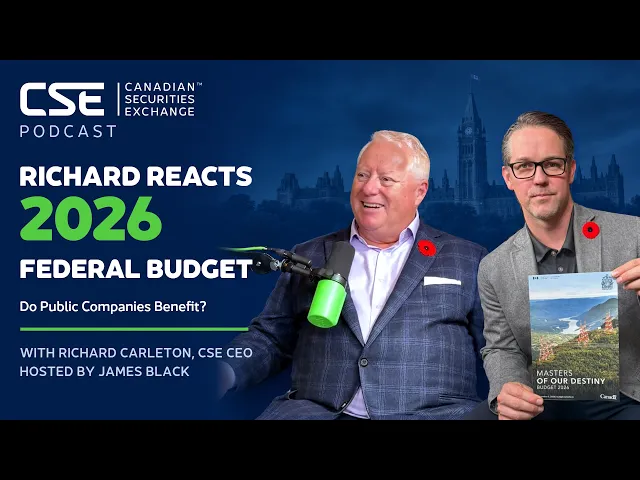
About This Video
Our latest CSE Podcast episode is live — and this one tackles a major policy shift with real implications for Canadian public companies.
Host James Black sits down with Bryan Watson, Managing Director at CleanTech North, to break down recent changes under the Budget Implementation Act (C15) — and what they mean for innovation funding in Canada.
Spotlight topic: Unlocking SR&ED tax credits for public companies
For decades, refundable SR&ED tax credits have primarily benefited private companies — but new legislation changes that. Public companies can now access the same non-dilutive funding mechanisms, creating meaningful runway for innovation across sectors.
Timestamps:
00:00 Introduction & overview of C15
02:00 What changed in SR&ED eligibility
03:50 Why this matters for public companies
05:15 Non-dilutive funding & runway benefits
06:25 $6M expenditure threshold explained
07:20 What qualifies as SR&ED activity
09:50 Industries that can benefit (tech, mining, biotech)
13:30 Eligible expenses: salaries vs. capital
14:55 Financing SR&ED receivables
19:05 Documentation & audit considerations
23:10 Final thoughts & key takeaways
“Why should we penalize companies based on their source of capital?” — Bryan Watson
With billions allocated annually and new accessibility for public issuers, this shift has the potential to reshape how Canadian innovation is funded — particularly in tech, biotech, and resource development.
Subscribe for more great CSE insights and interviews here: https://go.thecse.com/CSETV-Subscribe
STAY CONNECTED WITH THE CSE
=============================
- NEWSLETTER: https://go.thecse.com/CSE-Mailing-List-Subscribe
- PODCAST: https://blog.thecse.com/cse-podcasts/
- INSTAGRAM: https://www.instagram.com/canadianexchange/
- LINKEDIN: https://ca.linkedin.com/company/canadian-securities-exchange
- FACEBOOK: https://www.facebook.com/CanadianSecuritiesExchange/
- TWITTER: https://twitter.com/CSE_News
- BLOG: https://blog.thecse.com/
- WEBSITE: https://thecse.com/
- MAGAZINE: https://issuu.com/thecse/docs
Read the TranscriptAuto-generated by YouTube; names and terms may be misspelled.
Welcome everybody to the CSSE podcast and today I am thrilled to be joined by Brian Watson, managing director at Clean Tech North. I'm James Black from the CSSE and we're going to be talking about C-15. What is C-15 and ultimately what does this mean for public companies? This is budget implementation act. this is something that was recently passed and is going to have a profound, at least
potentially profound impact on public companies here in Canada. And I've got no better expert than Brian here joining me today to talk about this and shred tax credits and in the wonderful world of of [snorts] funding public tech companies. So Brian, welcome to the episode and thanks for finally joining me. >> Yeah. No, glad to be here after long last. And you know we talked about
this I think when the when when this was originally these changes were initially actually announced. We were working on them well before they were announced in December 16, 2024. we started talking about this and well it's not 2024 anymore. It's taken a little while. So I'm glad we're finally here. >> Yeah. No, I mean there's been obviously some changes in government and some legislation which was was waiting for
its day and but here we are. And I know there's been a lot of and I'll give credit to to other exchanges as well in Canada. There's been a lot of support behind these these new changes to the act. And maybe just to talk quickly to the guest because what we're really trying to exemplify here with this episode is that you know the public companies the public technology
companies have been sort of deprived of some real advantages that have been in the domain of private sphere. And now now this opens up a whole new world of tax credits for for research. And so let's let's get back to the basics here. What happened in the bill? Who does it impact? And some of the real highlevel elements of this. >> Yeah. [snorts] So, so I mean I think you
know for this audience, we'll go through all of them, but for this audience, you know, the the the the major the the biggest change is as you alluded to shred the R&D tax credit that's been around for more than 30 years now. has traditionally been much more beneficial to CCPCs, Canadiancontrolled private companies. Private being the problem there for companies that are listed. And I've
known many companies over the years that have had to go public. There wasn't the type of capital in Canada to fund their operations and their growth. So, but there was on the public market, so they went public. Makes sense. But they were all always penalized by losing that refundability, that cashback nature of that tread. And and for literally decades, I've been asking the question, why should we penalize
companies based on their source of capital? I can understand if a company's, you not Canadian control. I can understand if it's, you know, just listed, you know, on an exchange and it it has no operations here. But why based on their source of capital being private or public? And so that question actually resonated and you know after a rather protracted but finally done process that has now been changed.
a lot of people thought that this had actually changed as of some of the votes that were going on around the the the the budget in the House of Commons. But until that final royal ascent which was March 26th, it wasn't legal. you know the the House of Commons had passed it, Senate hadn't, the Queen now hadn't ased to it.
so it was not in the income tax act. It is now revised because that has passed. So, you know, it's been a long path, but as of now, companies when they get the actual forms from CRA and various other things will be able to claim effective December 16, 2024, which is interesting. so you can kind of back claim quite a bit. >> Okay. Potentially. they'll be able to
claim refundable shred at a higher rate for something that's a new definition. ECPC's, so not Canadian controlled private companies, eligible Canadian public companies because why not make the acronym sound almost exactly the right? So if you're private, you can still get it, but if you're public, you can now get it. >> Now get that cash back feature, which is great because again, you know, early
stage companies that have listed, you know, they may not be seeing revenue for a decade. >> You're giving them a tax credit basically that is a, you know, a deduction off that first year tax owing year. >> It's nice. Don't get me wrong. It can be nice, but it certainly doesn't help fund the operations for those intervening 10 years. Think of a biotech company. Think of, you know, some of the
companies on the critical minerals side and the processing side. I mean, they may not see their operations off up and running. So, they're in a taxable position for quite a long time. so this is really a gamecher and will really enable a lot of companies to to not shy away from some of the public markets because they're going to lose that refundable tax credit which
for for many companies can be in in you know up to a couple million bucks. that's material. so so yeah that's the biggest single change and I can get into the other ones as well. >> Yeah, we'll jump in that for sure Brent. I mean, it's non-dilutive, too, in the sense that you're getting money back they've already spent. You're not going into the markets and taking on new share
capital, giving up a piece of the pie at an early stage when your valuation is, you know, obviously the most exposed because you're, you know, many cases these companies are not huge, right? >> And so, and you're right, pre-public or public, a lot of companies are in the pre-revenue stage and, that obviously is, you know, something where valuation is also a tricky, proposition. And obviously in the public
they have a public value and that's that's cool. But to have this runway is what I call it the added runway through this this mechanism is is phenomenal. I just want to ask a couple questions before we talk about eligibility and and and all that but the I'm looking here. It's 5 million eligible expenditures. >> Was that six now? So now yeah. >> Okay. So that was that's I feel like
they might have even gone up. So, >> well, so the original proposition in the in the budget, >> sorry, in the in the fall economic statement 2024, I believe, was 4.5 and then in the in the budget, they actually upped it to six. >> Oh, wow. Okay. >> And over what period of time are companies allowed to >> per year? >> Per year. So, yep. you've you're able to
pull down the shred rates based on expenses up to 6 million versus 3 million prior prior to prior to now. >> Phenomenal. Okay. And when you talk about eligibility, maybe let's jump into that pool. The the types of expenses, the types of companies that should be looking at this tool. where would you start that thought process? >> Yeah, exact. Well, that's a great
question. So, so we'll go back to the the the the definition of shred. Basically, >> [snorts] shred is based off pushing the bounds of particular types of technologies and getting into that realm where nobody really knows how to solve the problem or if they do, they're probably not going to tell you. Google might know how to solve your algorithm problems, they're probably not going to tell you. so,
you have to basically start running experiments. Now, that could be shopf flooror manufacturing experiments. we don't know how to make this particular food product dry in a way. So there's it could be food science, it could be al statistical science, any domain of science classical science, social sciences not so much but any domain of science, engineering where you are, you know, where there's
no known answer. so you have to really ask the questions of you know you've done your research you've gone out there you've you've you've looked at the the literature reviews you've looked at you know you've talked to the supplier of the technology they've shrugged their shoulders and said yeah you're not supposed to use it that way but you need to use it this way you
know anything where you're pushing the bounds of those specific pieces of technology is usually grounds for starting a conversation of shred where you take on a you know basically experimental process to try and solve that problem. You know, it might involve bubble gum and duct tape. It might involve a bunch of engineers. it might involve a lot of rapid testing with software. every industry is a
little bit different. Software tends to be a lot of really rapid iteration. bio you know drug discovery usually not as rapid iteration. So you know the timelines are different. It could be many many years that you're in that experimental phase. But each year you can file as long as you're documenting things properly, and we can talk about the documentation side later. but as long as you're substantiating
your claim, as long as your work is is eligible for shred, >> [clears throat] >> you're entitled, which is an important word, you're entitled to that refund. So, it's not a grant where there's a bunch of folks sitting around in a back room saying, "I like that this company, or I like this one." No, you if you as long as you qualify on the technology and you can substantiate the
cost associated, you get that money in and it's enshrined in the tax code. >> It sounds like a bottomless pit. >> But it's about $4.5 billion. >> so and I believe with the changes the parliamentary budget officer has expanded that to about by about 1.5 billion I believe. so you're looking sort of sixish, seven. >> Yeah. And I think in general we can
agree that the more that's claimed against it, the better. >> Yeah. I mean, real realistically, this should be funding the productive capacity building for Canadian companies. And it's interesting, one of the other aspects of of these changes, reintroducing capital. You know, I' I've got a number of folks in the academic and accounting world that, you know, we've we've seen a lot of commentary around Canada's overall productivity
dropping. and some of them have correlated the numbers starting to drop as of when they removed capital from shred in 2014. So about a decade ago, you couldn't experiment with large equipment. You had to buy this and you know, it didn't work. You were taking technological risk and then it didn't work. Well, you know, are you going to repeat that process over and over again? It's costly. Now, if that shred at least
generates a 40% tax credit on on on on the capital cost, you know, it mitigates the risk. and so, you know, it'll be very interesting to see if we start seeing an uptick in Canadian productivity and investment in in in in hard technology. Yeah, I mean there's certainly a narrative that we're losing out to other nations as far as that and this is a necessary step
to help home brew more, you know, worldass technologies and and train people and u create new IP in Canada that has a global appeal, right? and and and keep the corporations here too and frankly from the CSC's perspective and from the public markets perspective maintain more companies and attract more companies into the public listing sphere you know >> so they can access you know public
financing and and obviously everyone kind of hopefully does well under that that that construct. >> Absolutely. >> Yeah. So we talked about eligibility in general sense. it sounds to me this is not just you know your typical science experiment company. This could be a operator that's [clears throat] you know like a mining company. They're looking for minerals but they also have you know something as far as an
equipment. >> I've seen cavitation technologies to separate tailings ponds from critical minerals. You know building those technologies. is I've seen you know refining technologies technology companies that have projects so they actually have an active mine and which isn't a criteria but you know often it's the case that they are experimenting with technologies to get the optimal amount of whatever out of say a tailings bond or you know companies that have
extraction technologies they're not public but you one like Destiny copper which which which is has a very low energy extra raction technology for copper. That's great. A, it's clean tech, too, which I love because it reduces the amount of energy that it takes to smelt things out of rock, but b you know, it is a new technology that they're experimenting with and and could
lead the way for cleaner, greener copper, without the rust. right now. In the realm of AI, I'm assuming this isn't something that you can leverage to go and hire an army of AI bots to do, you know, marketing campaigns, but something >> not generally. I there's probably some shred in there somewhere, but >> yeah. >> Yeah. No, I mean Shred is based on primarily historically on on on the
brains salaries of folks that are and and and contractors, employees and contractors all has to be in Canada basically. everybody get everybody's getting a T4 whether it's your company or the company that it's contracted with. >> but now we're adding in some of those other expenses like like capital and things like that. So >> So equipment. >> Yep. Capital equipment. So, so you know,
it could be a a clean room for your drug discovery or medical tech medical technology company. a clean room might have to think about but there are some some exceptions like clean rooms buildings usually aren't aren't eligible, but you know capital that is necessary to do the experimentation side. >> Gotcha. Gotcha. >> Yeah. and an AI company there's not the
capital usually but there is statistical science so you might have 30 statistical scientists working on a whizbang algorithm to do something >> that their salaries would be eligible but they but but they wouldn't necessarily have the capital component to their expense base. >> That's incredible. And so yeah and as far as the tax credits are concerned you talked about the ability of these to be financed.
>> Yeah. >> Yeah. So so historically so I' I've been working with a firm Venbridge and and easily and so easily historically for the last number of years has been financing shred. so that government receivable, the problem with this, the the shred is and there's been other jurisdictions that have have worked on this to do prepayments and various other things. But if I incur a big expense, my my I've
got a December 31st year end. I incur a big expense to Q1. >> I can't file my taxes until December 31st of that year. So that's, you know, 8 months, 10 months. And even then, I'm not going to file my taxes in January generally. it'd be nice if everybody was that on the ball. It usually takes a good you know 3 months, sometimes six to get those taxes filed and audited and
and everything else. And this may be an increased issue with public companies because there's a little bit more diligence on that than private ones. so then you've incurred it in January, you didn't file your taxes till the next, let's be let's be optimistic, end of March the next year. And then CRA has to review the file possibly audit it. It might be, you know, a year and a
half, two years from when you incurred that expense to when you're getting the value check. So shred financing historically has financed that on a quarterly basis. That's what easily does. pulling that receivable forward, factoring that receivable from the government based on, you know, your shred consultant generally that you're working with, work, the work that they're doing, whether it's you employment hero or another one that that that they pull together all the
salaries, they pull together the capital, they give an estimate to uneasy and say, "Look, this company, you know, credibly, we've done the math, we've looked at the projects, they're probably going to get $500,000, >> right, >> this quarter." So, you know, depending on the lender, easily it's about 80% loan to value. so, we could fund $400,000 of that. That means you can use that capital in that fiscal year rather
than waiting 16 months, 18 months, you know, to get that money out. the other end, if you don't need the cash, let it sit there. But I don't know a lot of companies that don't need a little bit of liquid cash right now. even just to soak up some of the exogenous shocks that keep happening in the market these days. So >> the market is unpredictable. Yeah. But
and again to your point about the impact of public companies and for sure this conversation is going to be one of many that that follow it around this and how to leverage it. But yeah it matter of disclosure absolutely you're taking on financing but the you know the one thing the market likes is the less lumpiness in your financials the better and obviously in small cap
that's that's tough because there aren't you know often consistent revenues amongst especially an exploration company there's no revenue. but certainly what you're trying to do is buy time. if you're a mining issuer, you're trying to buy more time on your property and more drill holes and more more testing and results >> y that you report back to the market because that's sort of the ammunition
you need to go and get financed. >> And then with the tech side, I mean, every story is different. We've seen these these companies all have a different narrative and the market shocks you mentioned. I mean, you could be in the blockchain space. You could be in crypto. You can be in AI or a combination of all those and sending >> experiencing the SAS apocalypse that's happening right now or the biggest one
I've heard is the assassination. You know, it's there's lots of there's lots of shocks out there and having a little bit of flexibility in your cash to be able to absorb those elasticity in there makes all the difference. >> No, disruption is a consistent. That's an oxymoron, but >> Okay. And just a couple last points, Brian, but making sure you're working with a reputable firm or someone knows
what they're doing. You just mentioned it. So, there's modeling, there's some prediction based on the financing side, but even just the application preparation. So, what high level items should people be prepared to you know, be ready for when they go and file? >> Yeah. So, so first off, the historic one, which is, you know, generally salaries. a that the work is all done in Canada. So, if you've got
contractors, have it in your contract that all work is done in Canada and that you own that shred. Just write it into the contract. Keeps it simple. but then, you know, further to that, what what what substantiates shred is the amount of time that you are working or your engineers or the people that are doing the shreddable work are doing shreddable things. You can have people
that are, you know, doing front end on a software company backend and you know, you know, they're actually, you know, in insane evil genius, statistitians doing weird algorithms, but they're also doing the front end of the website, the how it looks and everything else. The front end stuff generally not eligible. It's the creative, it's the, you know, that sort of stuff. The backend stuff absolutely eligible though. So, you
know, having the time sheets, this is one of the reasons I like things like employment hero. They have the HR management system. they've got all the time sheets, so they got that evidence naturally generated. >> And so, you've got to be able to parse Tom's salary or Sally's salary between that eligible and non-eligible. to a fairly granular degree. there's lots of methodologies for capturing that evidence. but, but you've got to
substantiate that Tom and Sally are spending 42.6% and 37.8% of their time on shred. And then you know that and that's multiplied through to the eligible expense base that that has now grown in terms of six million versus three but you you need to substantiate those expenses there on the capital side introducing capital now you know you need to be able to substantiate that the piece of capital a
you know whatever the widget is that you needed to test your shred your hypothesis you know test the solution to your problem that that that that capital is being used to a certain threshold. If it's 100%, you don't use it for anything else except to to solve this problem. No problem. Just 100% shreddable. You get 40 40% credit on that. and and you're good. But a lot
of capital, that's not the case. It may be mixed use. so you need to substantiate and even for the 100%, you need to be able to substantiate that it's 100%. And if it's not 100% you need to substantiate between, you know, 50 and 100% or 50 and 90%. You know, is it 75%. If it falls below that 50% threshold, that is another treatment and you you
may not be able to claim it. And it also impacts things like capital cost allowance and depreciation and various other things as well. So, so you know, we won't get into the into the the accounting weeds of that. I'll leave that to my wonderful CPA Canada working group for that. but the crux of it is you need to be able to prove to CRA that you are documenting the
experimental process for one. Yeah. >> And then the amount of resources that are allocated to that experimental process to a fairly granular level and just keeping up to keeping a log book, keeping the time sheets, you know, those sorts of things are all good ways to substantiate that. So yeah, there's lots of literature out there. Happy to talk about it some other time. other other ways to document this stuff. but you
need to that because you know these are all subject to audit. They can be big numbers and so CRA has been you know with for example the new clean economy tax credits they're right now at a 100% audit rate because they were new. How are they going to treat the ECPC's and the capital cost claims? >> I don't know. it could be subject to a 100% audit rate. It might not be.
we don't know yet. there there's no there's no stated policy right now. I'm hoping that it's not I'm hoping that it's a what's you called a risk based audit where they look at it and you know assess whether there's a real risk here of of fraud or not. and and and go from that. but we just don't know. >> We just don't know. so just to recap,
$4.5 billion are tagged in the budget >> for shred historically. >> Shred. >> Yeah. >> Yeah. could be higher. You know, again, our hope is is this provides more life to the public company sphere in the sense that >> you've got companies that you know, again, every dollar counts and and every project you know needs life in the form of funding and and this this definitely gives runway to to companies
now that are in the public space that are doing these innovative projects. and as we just discussed, there's there's other industries, too. So, I'm looking forward to this just we're we're just at the beginning now of even though it's been a long process to get here. We're just at the beginning, Brian. [snorts] any any resources other than I'll mention this. The article you wrote, it's on beta kit. Came out yesterday,
April 1. It wasn't an April Fool's joke, which was >> no, >> even better. In the title of it, it's Canada's budget bill is finally law. Here's what here's what that means for for innovation. I'll put the link below. It's a great read. It's a good starter. Hopefully this conversation was a good starter. Brian, anything else you want to mention on this before we
leave you for the day? >> No, I mean I think I think really, you know, the key is going to be working with folks that know what they're doing in this sphere. There's a lot of change. There's likely going to be audits. We've seen them with the clean economy tax credits, which some of your companies may want to take advantage of with the things like the clean technology
manufacturing tax credits, which are eligible for critical minerals extraction and processing. So 30% refundable. So that's good. But but you know, we can do another session on those. But honestly, I I think that the biggest key, and this has been the the case for Shred forever, make sure you're working with a reputable firm that knows what they're doing. And make sure you keep your evidence because there's
nothing worse than, you know, having gone for 3 years without an audit and all of a sudden maybe you got a little lax on your evidence. That's the time when you're probably going to get audited. So you always want to make sure because it's a material amount of money for a lot of companies. So keep that evidence and and stay tuned. We will be talking about any
changes, how the audits are rolling out, things like that. and there are some moving targets. we have advocated for things like IP costs to be included in there with potential clawbacks if the company's sold outside of Canada. So there are definitely some more changes potential for potentially for the shred program in the near future. so watch this space and we'll certainly happily update you on
and any others. >> That's great. Okay. Well, Brian, thanks so much. That's Brian Watson, managing director of Clean Tech North based sort of around Toronto and we'll we'll be talking very soon, Brian. Thanks again for joining me after all this time. >> Wonderful to see you. Thank you very much. We'll talk soon.