
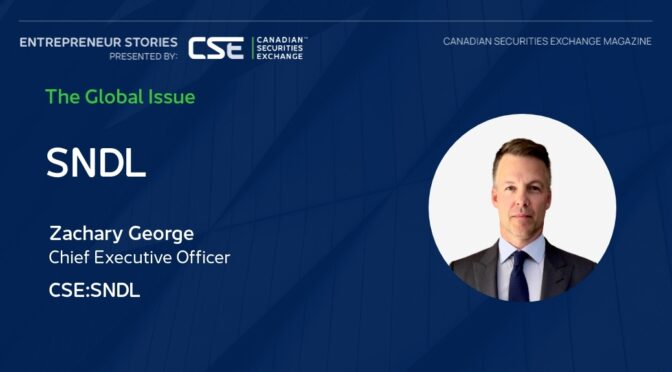
North America’s legal cannabis industry is still in the early stages of development, shaped by complex regulation, high taxes, and fierce competition – pressures that only the most capable management teams can navigate.
That dynamic is clear when speaking with SNDL (CSE:SNDL) Chief Executive Officer Zachary George, who anticipated how the industry would evolve, the points of differentiation that would matter, and how businesses would need to steer through the turbulence.
George knew the value of a long-term perspective. Inheriting Canada’s largest, but non-competitive, indoor cultivation facility, he worked to reshape a debt-laden, unprofitable business into a retail-forward regulated products model, adding alcohol as a stable cash flow anchor. The move gave his cannabis operations runway to mature, and the results are becoming clear: earlier this year, SNDL posted its first quarter of positive operating and net profit.
Canadian Securities Exchange Magazine spoke with George recently about SNDL’s formative years, his philosophy for the business, and medium-term expansion plans.
SNDL has built a successful cannabis business within a broader overall product portfolio. Where did this idea come from and what were some of the important milestones in the early days?
The business as it stands today was born out of a deep restructuring process. Once we were on the other side of the restructuring, we sought to build a diversified business model with two strategic pillars.
The first pillar was a vertical cannabis model, the likes of which did not exist in Canada. The second pillar was a financing business that would enable us to, in a compliant manner, invest in U.S. operators by being a passive supplier of credit, without running afoul of the restrictions that exist for Nasdaq-listed companies when it comes to what we call “plant-touching” operations in the United States.
That evolution took a number of twists and turns. Our first foray into retail happened with the acquisition of Spiritleaf in Canada in July of 2021.
Later that year, we were approached by Nova, the company behind discount banner Value Buds, which had quickly become a disruptive force. At the time, Alcanna, Western Canada’s largest private market liquor retailer, owned 63% of Nova. From a sum-of-the-parts perspective, it made more sense to acquire the parent company than to pay a premium for the subsidiary. The deal also gave us access to a leadership team with decades of regulated product retail experience. Many of the same value and convenience themes that drive consumer behaviour in alcohol are directly analogous in cannabis.
The scale that came from the Alcanna acquisition was critical to our model. As an SEC registrant subject to Sarbanes-Oxley Act requirements, we are subject to some of the most stringent financial reporting and internal control requirements on the planet. Given the costs related to these requirements, playing small was not an option, and we had to do something at scale. The liquor business contributed significant free cash flow to the overall model, which helped to mitigate these costs.
Let’s look at the business portfolio, which is almost evenly balanced between liquor retail and a multi-faceted cannabis business. Can you walk us through the liquor side first and outline its competitive advantages?
SNDL holds significant market share in Alberta and a strong presence in British Columbia. However, each province presents unique regulatory challenges that shape our strategy.
When you talk about competitive advantages on the liquor side, I would point immediately to the success of the Wine and Beyond model. Building a capital-intensive retail model requires strong supply chain management and the ability to seize inventory opportunities in a decisive manner. In our Wine and Beyond locations, consumers can choose from more than 6,000 SKUs, and that breadth has really resonated. Our big box format stands in stark contrast to the consumer experience available in Ontario’s LCBO locations. We are seeing the model materially outperform more limited, convenience-focused formats.
We are expanding that part of the business and are excited to be opening another two new Wine and Beyond locations in Saskatchewan and a third in Calgary in the coming months.
On the cannabis side, you have a hybrid, vertically integrated model. Tell us about the structure and the thinking behind it.
A couple of observations are important. Canada’s provincial cannabis regulations are inconsistent, with some even contradicting one another. This dynamic creates stubborn supply chain inefficiencies that are anti-business and a disservice to the provinces, operators, and consumers alike.
In certain provinces, retail sales are managed by private operators working within a tightly regulated framework, while in others they are controlled and managed exclusively by the government through crown corporations. Of those provinces permitting private operators, some allow for full vertical integration, while others bar or limit licensed producers (LPs) from retail ownership. In British Columbia’s hybrid framework, private retail operators like us are capped at eight retail locations, while the province competes against us with over 40 of its own, and other operators skirt these regulations with complex ownership structures. In Ontario, a licensed producer is prohibited from owning more than 20% of a retail operator, while regulations in the Prairies allow for vertically integrated structures.
Provincial fiefdoms within crown corporations have preserved inefficiencies while failing to prioritize important public goods such as the optimization of consumption-based tax revenues and consumer safety. At the core of these issues is a question as to whether Canadians believe that their tax dollars should be used by provincial governments to directly manage consumer-facing retail operations.
This is a departure from conventional consumer packaged goods (CPG) where brand awareness, efficient manufacturing, and clear routes to market can drive access to broad growth across a national market. The inherent inefficiencies in Canadian cannabis must be carefully managed. Instead of complaining about poor decision-making and weak enforcement by regulators and government bodies, we are directly involved in lobbying for rational reform. The steep and rocky path in the sector will ensure that very few competitors can survive. We are built for the climb.
Why did you choose a vertical structure?
With a mandate from our board to build a global cannabis business, we observed that in mature markets in the United States, the vertical operators in limited licence markets were by far the most profitable. Further, Health Canada’s restrictions and prohibitions on the marketing of branded products were a clear hindrance to building brand resonance with consumers. In sharp contrast to the regulation applied to alcoholic beverages, even something as simple as the depiction of a mountain on packaging, or the outline of an animal form, can draw fines and demands for the recall of products.
In today’s marketplace, regulated brick-and-mortar retail is the best place to own the consumer relationship. E-commerce solutions have also been stunted by regulation, further reinforcing this dynamic, although we expect this to evolve positively in the future.
In the early years, we saw a proliferation of products where brands themselves were being commoditized. We have the data from tens of millions of consumer transactions and know exactly where repurchase rates are. This data continues to show a strong willingness by the consumer to trial and switch products.
This dynamic created a strong desire to stay out of the fight among producers over whose pre-roll or flower strain was better. My focus was on building a platform that could track and adapt to consumer trends over time. Rather than competing in a sea of sameness with other LPs, I wanted to partner with them, helping to distribute and even manufacture some of their most successful products.
In doing so, we shifted from competing on products to competing on capability – building a platform that could support both our own brands and those of our partners. You will see our owned and co-manufactured brands in competitive retail, and you will see competitive suppliers dominate shelf space in our owned and managed retail network. We have a large B2B or co-manufacturing business building products for other LPs and have built quality products for most of the top 20 LPs in Canada today. We have automated manufacturing capabilities in every relevant product segment, including infused beverages, edibles, pre-rolls, flower, extracts, and vapes.
Let’s talk about performance. The second quarter of 2025 was SNDL’s first profitable quarter. What were some of the highlights?
Understanding the backdrop is really important. I am very proud of our team. Over the past five years, we have been able to grow our revenue base by over 1,500%. We have one of the cleanest balance sheets in the sector, with no debt and approximately $200 million in unrestricted cash to drive strategic investments. Last year was the first full calendar year that we generated free cash flow. We have hit new milestones and records almost every quarter for the past 14 quarters. In our most recent second quarter, we generated our first quarter of positive operating and net income.
We have announced the acquisition of a 32-door retail portfolio that we are working to close in October and have significant embedded growth coming from our credit investments. Some of those positions are being equitized and may be consolidated in the future.
We have also managed to buck some of the negative trends in alcohol consumption, which is a credit to the strong execution capabilities of our team.
As you look to the near and medium terms, how do you shape strategy given the competitive landscape and the opportunities afforded by your business lines?
We put together a three-year strategic plan supported by our board, and our priorities are clear. Our number one priority is to continue to grow our Canadian retail cannabis and liquor businesses. Second would be the stabilization and investment in U.S. businesses we have exposure to, including operations in Florida, Massachusetts, Texas, and Michigan, all of which have unique and distinct regulatory frameworks. Third would be international. We are excited to be landing finished goods in the U.K. and shipping wholesale flower to several international medical markets. Our segment leaders are focused on delivering profitable growth in our alcohol and cannabis segments in 2026 and beyond.
This story was featured in Canadian Securities Exchange Magazine.
Learn more about SNDL https://www.sndl.com/.