
When Canadian Copper (CSE:CCI) first set its sights on New Brunswick’s Bathurst Mining Camp, the goal was to acquire prospective ground and move quickly to unlock the opportunity beneath the surface. Home to one of the world’s richest volcanogenic massive sulphide (VMS) districts and the legendary Brunswick No. 12 mine, the region also offers a combination of infrastructure, such as provincial highways, a year-round deep-water port, skilled labour, and regulatory stability.
The company’s mission took shape in what management calls its Combined Strategy, pairing the Murray Brook deposit – the province’s largest VMS resource – with the nearby, permitted Caribou Processing Plant Complex. By repurposing an underutilized mill to process feed from a world-class deposit, Canadian Copper aims to fast-track its operations from exploration to production within three years, subject to permitting approvals.
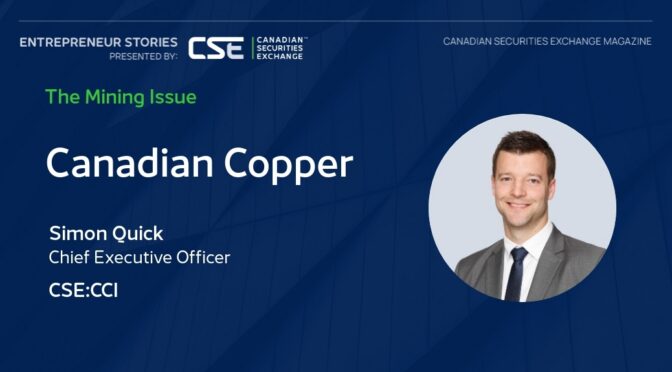
In this mid-January interview with Canadian Securities Exchange Magazine, Canadian Copper Chief Executive Officer Simon Quick speaks on themes ranging from global copper price trends to the company’s exploration priorities, and partnerships helping to turn its objectives into reality.
Canadian Copper has built a prospective land package in the Bathurst Mining Camp. What’s your big picture strategy for moving these assets forward over the next few years?
We chose the Bathurst Mining Camp because of its long history of critical mineral production. It was home to Brunswick No. 12, one of the largest underground base metal mines ever operated, producing copper, zinc, lead, and silver for nearly 50 years, something many people aren’t aware of.
That history brings real advantages. Jurisdictions with established mining legacies tend to have clear and robust regulatory frameworks; infrastructure such as ports, roads, and power; and a skilled workforce that knows how to permit, design, build, and operate mines. That made Bathurst an attractive location for us.
By focusing on a brownfield site with relatively low capital requirements, we’ve tried to reduce financing and permitting risks. Bringing in Ocean Partners gave us a strategic partner with the financial strength and technical expertise to execute our Combined Strategy. Ocean Partners are true partners, and I think every junior wishes they had this calibre of partner to develop an asset with.
Can you walk us through the Combined Strategy, which involves your Murray Brook deposit and the Caribou Processing Plant Complex?
The approach, both opportunities and challenges, of restarting brownfield sites isn’t unique in itself. What’s unique is this specific situation with Caribou. The site has operated intermittently for nearly 30 years, and the most recent operational challenge was mine throughput. The underground mine was deep and sometimes geotechnically challenging, suffered from dilution, and lacked underground drilling definition, so it could never consistently feed a mill sized for 3,000 tonnes per day. At its peak from 2017 to 2019, it averaged about 2,500 tonnes per day. Thus, the mill ran well but was always underutilized.
For us, the question was whether we can solve that throughput challenge and repurpose the mill. It’s permitted, built, and has a tailings impoundment. Roughly 10 kilometres away, we have the largest open-pit polymetallic resource, Murray Brook. By combining the two, you have complementary needs: a mill that needs throughput and a deposit that needs a mill. For us, it’s really a one-plus-one-equals-three transaction, and that’s the strategy behind the business.
As just noted, Murray Brook is New Brunswick’s largest VMS deposit. What are the key milestones in 2026 that will show the project is on track?
Murray Brook is a true VMS deposit, with copper, zinc, lead, and silver. With today’s commodity prices, the revenue mix shifts constantly. When we did our preliminary economic assessment (PEA), silver was US$27 an ounce; now it’s over US$90, so silver has become a much more significant contributor alongside copper and zinc.
Looking ahead, we plan to officially close the Caribou transaction this quarter, subject to certain government approvals. Final closing and title transfer involves a $6 million payment for the restructuring, which then goes to court in British Columbia, and ultimately the title should transfer here before the end of March based on New Brunswick’s current schedule communicated to us. After that, we’ll continue to advance engineering and permitting, with the goal of submitting the Environmental Impact Assessment in the first half of 2026.
By the end of the year, we aim to deliver a feasibility study that demonstrates engineering progress and develop necessary input data for permitting needs. This year, we hope to have the transaction closed, the permit submitted, engineering largely complete for the feasibility study, and the execution team staffed and ready for early works.
Can you walk us through the key exploration priorities for Canadian Copper this year, and how you plan to advance both the Murray Brook deposit and the surrounding regional targets?
There are three areas of exploration we’re focusing on for the combined company. First is the Murray Brook deposit itself. There are some extensions to the west that remain untested, with promising copper and gold intercepts. We have a 13-hole drill program planned to test that area this year.
Once we’ve consolidated the property package, as in close the Caribou transaction, we’ll control roughly 20 kilometres of the Caribou Fertile Horizon. That area has already delivered three producing operations, but we believe it’s still largely untested, especially using modern geophysics. We plan to conduct geophysical surveys across the region to help refine future exploration targets.
Finally, for Murray Brook West and Murray Brook East, we have follow-up drilling programs planned, including targeted exploration drill holes and larger-scale trenching to refine additional targets, guided by the results of our geophysical work.
You completed metallurgical drilling in 2025. Were there takeaways that shape how the project moves forward?
It’s still early days for the metallurgical test work, but one positive to note from the drill program is that our mineral resource model reconciled well. We re-drilled historical holes to target specific grades, lithologies, and resource depths, with the goal of confirming Caribou’s plant performance with the Murray Brook ore body. The drill program confirmed that our resource model tracks well in terms of what we anticipated to drill in terms of grade and depth, and the commodities matched what we encountered, which is encouraging.
With copper demand increasing and some commodity prices at record highs, Canadian Copper seems well positioned given your eye on production.
We’re targeting production within 36 months, which we believe positions us well in the current commodity environment.We’ll be one of the few junior miners able to reach production in 36 months, which positions us to take advantage of rising commodity prices. The supply side of copper is clearly under pressure: grades are declining, historic South American operations are getting deeper and more costly, and social acceptability remains challenging, certainly for new builds and expansions to existing operations.
At the same time, demand continues to grow. Traditionally, copper demand followed economic cycles, but with electrification, that dynamic is shifting. Industrial demand still fluctuates, but electricity-related consumption is steadily rising, creating an imbalance likely to support higher prices in the medium term.
Geopolitically, uncertainty around the U.S. dollar and global trade is driving investors toward hard assets like commodities, and being in North America is a big advantage.
For miners in Canada, this is the first administration in years that is genuinely pro-domestic mineral production, supporting investment, permitting, and critical mineral development. Combined with New Brunswick’s long mining history and excellent infrastructure, including a five-terminal port just 30 minutes from our site, we can export concentrates globally without the need for additional capital. That existing infrastructure is a major benefit for advancing our projects efficiently and cost-effectively.
You’ve brought in strategic investors and raised significant capital recently. How do these partnerships help advance your development plans?
We raised $15 million in Q4 of last year, mostly from strategic investors. By that, I mean groups with financial expertise in mineral resource development that understand the mining business, including partners like Crescat Capital, Stephens Investment Management, and Ocean Partners.
Looking ahead, we’re well funded for the acquisition, and we’ll be exploring additional financing to advance our development strategy. There are opportunities to do this on less dilutive terms through offtake agreements, streams, or royalties. We expect to make decisions on the structure in the first half of this year, depending on what makes the most sense for the project and our shareholders.
Finally, looking ahead, what does success look like for Canadian Copper both on the ground and for your shareholders?
On the ground, our key milestones are clear: deliver a study by the end of this year, obtain construction approval in 2027, and reach some level of production in 2028. Those are the three main measures of success for us as a business.
From a stakeholder perspective, if we continue to deliver on what we promise, minimize dilution, and ultimately increase the share price, that’s where investors’ interests should align. It’s aligned with management, too. We don’t take large salaries here; our personal investments are significant, and the way we succeed is the way our shareholders succeed. So, our focus is on share price appreciation but also on delivering what we say we can deliver.
This story was featured in Canadian Securities Exchange Magazine.
Learn more about Canadian Copper https://canadiancopper.com/.